Studebaker Electrics
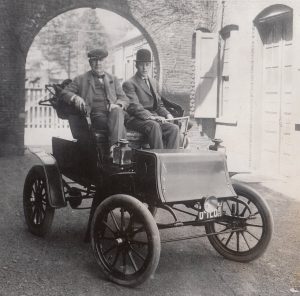
Studebaker entered into automobile manufacturing in 1898 when Fredrick Fish, Chairman of the executive committee, persuaded the board to supply $4,000 for the development of an electric car. However, without the board’s full support, the project yielded only one car. The company did, however, began producing bodies for electric taxis for Alexander Pope’s Electric Vehicle Company (EVC). EVC provided electric taxis, to compete with horse drawn taxis in many major cities through out the US. However, EVC was bankrupt by 1902. Studebaker started production of it’s own Electric cars in 1902. Thomas Edison (so the story goes) purchased the second of twenty electric cars manufactured that first year of production. Edison (photo to the right) supposedly used that car for the next 23 years.
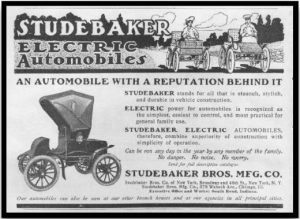
Specifications of Studebakers “First Electric Car”:
- Drive: Chain
- Steering: Tiller
- Power: Westinghouse electric motor
- Gears: Four forward speeds
- Brakes: Duel
- Speed: 3, 5, 9, and 13 mph
- Range: 40 miles.

Starting in 1904, Electric cars were made available in a variety of body styles, which mimicked bodies Studebaker had produced for its passenger carriage line. These included Stanhope, Victoria, a four passenger model, and a light delivery. Max speed increased to 14 mph. In 1906 a four passenger coupe and a stake truck were added. From “Studebaker The Complete Story” written by William A. Cannon and Fred K. Fox, the initial models offered were (2) Runabouts, (1) Trap, and (2) Stanhopes. By 1910 production was down to a trickle, as focus had moved to gas car production. Studebaker manufactured 1,841 electric car before production ended in 1912.
Garford Production
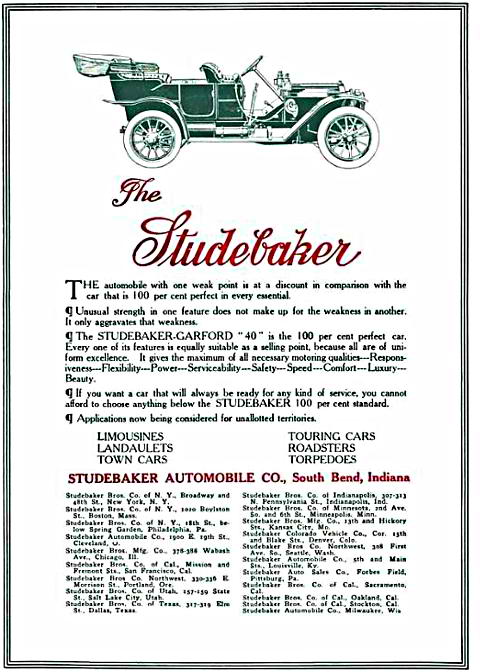
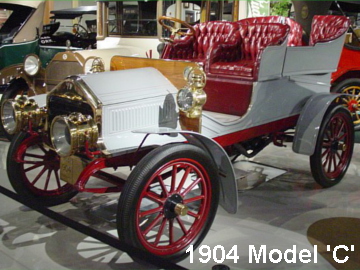
In 1904, Studebaker began production of gasoline powered car in partnership with Garford Company of Elyria, Ohio. Under the agreement, Garford would ship completed chassis and drive trains from Ohio and then Studebaker would mate them with Studebaker built bodies. They were sold under the Studebaker-Garford brand name. Eventually, even the Garford built engines would carry the Studebaker name. Garford also built a limited number of cars under its own name, and by 1907 attempted to increase their production at the expense of Studebaker. Once Studebaker discovered what was going on, Studebaker enforced their primacy clause, forcing Garford back onto the scheduled production quotas. In 1906 Garford, in order to fund it’s expansion plan, had allowed Studebaker to become a minority investor, giving Studebaker three seats on the seven-member board, Garford expected to control the board with the remaining four seats. But Hayden Eames soon went over to the Studebaker side, giving Studebaker control of the board. Studebaker continued to acquire more shares and by 1908 Garford, was a minority stock holder in his own company. However by 1910, Studebaker was finding it impossible to attain the sales volume they wanted with Garford’s limited manufacturing facilities and high prices. The decision to drop Studebaker-Garford was made and the final product rolled off of the assembly line by 1911 or 1912. Studebaker sold it’s interest in Garford’s company to Willy-Overland, in 1911 or 1912, leaving Garford to try it alone until finally Garford’s shares were acquired by John North Willys in 1913.
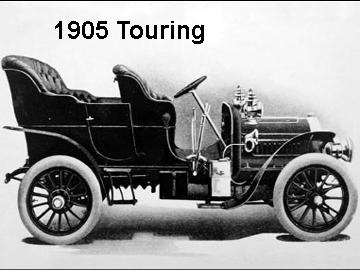
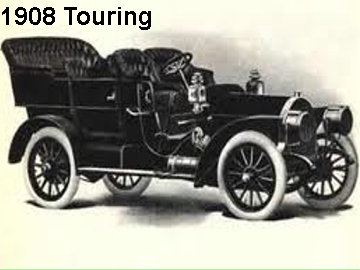
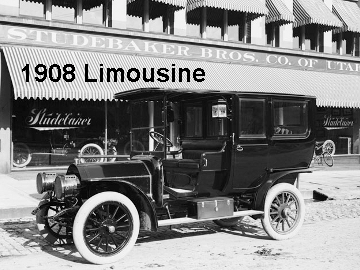
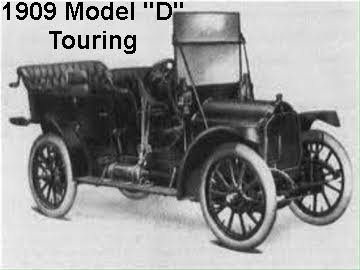
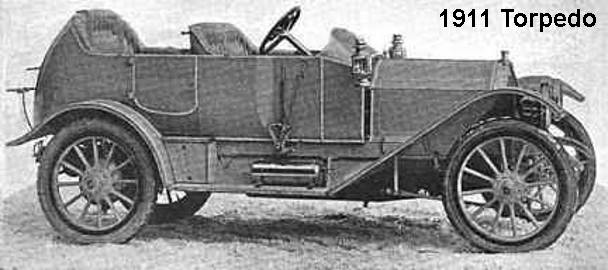
I found very little information on exactly what body styles were offered in what years. From Thomas Bonsall’s “The Studebaker Story”, we find the first car (1904) was a touring car with removable tonneau. Several sources on the internet indicate, that when tonneau was removed, this then became the two passenger runabout. Bonsall, further states for model year 1905 a touring car was added to the model “C”, renamed the 9502 line-up. Thus, one could conclude this was in addition to the existing runabout which had lost it’s removable tonneau. The model 9503, a longer wheel base, four cyl. model was also added. But, Bonsall does not mention what body styles were offered in this range. One could guess however, the two passenger runabout and a touring car. For 1906 the model 9503 was carried over as the new year model E, along with two totally new models, the F & G, adding additional wheel base and horse power options. No mention of body styles is offered. Bonsell, indicates the 1906 models were carried over to 1907 as the model L, G, and H respectively, with little change and still no mention of body styles. In 1908 the model “B” is added, a 40 HP 114 inch wheel base model, but as before, no body styles are mentioned. Bonsall did not cover the Garford, after the 1908 model year.
Year | Model | Series | CYL | HP | WB | Cost | Production |
1904 | C or 202 | Garford | 2 | 16 | 82 | $1,600.00 | 20 |
1905 | 9502 | Garford | 4 | 16 | 82 | $1,250.00 | Unknown |
1905 | 9503 | Garford | 4 | 20 | 96 | $3,000.00 | Unknown |
1906 | E | Garford | 4 | 20 | 96 | $2,600.00 | Unknown |
1906 | F | Garford | 4 | 28 | 104 | $3,000.00 | Unknown |
1906 | G | Garford | 4 | 30 | 104 | $3,700.00 | Unknown |
1907 | L | Garford | 4 | 20 | 96 | Unknown | Unknown |
1907 | G | Garford | 4 | 28 | 104 | Unknown | Unknown |
1907 | H | Garford | 4 | 30 | 104 | Unknown | Unknown |
1908 | A | Garford | 4 | Unknown | Unknown | Unknown | Unknown |
1908 | H | Garford | 4 | Unknown | Unknown | Unknown | Unknown |
1908 | B (Fourty) | Garford | 4 | 40 | 114 | Unknown | Unknown |
1909 | A | Garford | 4 | Unknown | Unknown | Unknown | Unknown |
1909 | B | Garford | 4 | Unknown | Unknown | Unknown | Unknown |
1909 | C | Garford | 4 | Unknown | Unknown | Unknown | Unknown |
1909 | D | Garford | 4 | Unknown | Unknown | Unknown | Unknown |
1910 | H | Garford | 4 | Unknown | Unknown | Unknown | Unknown |
1910 | G7 | Garford | 4 | Unknown | Unknown | Unknown | Unknown |
1911 | G840 | Garford | 4 | Unknown | Unknown | Unknown | Unknown |
1911 | G10 | Garford | 4 | Unknown | Unknown | Unknown | Unknown |
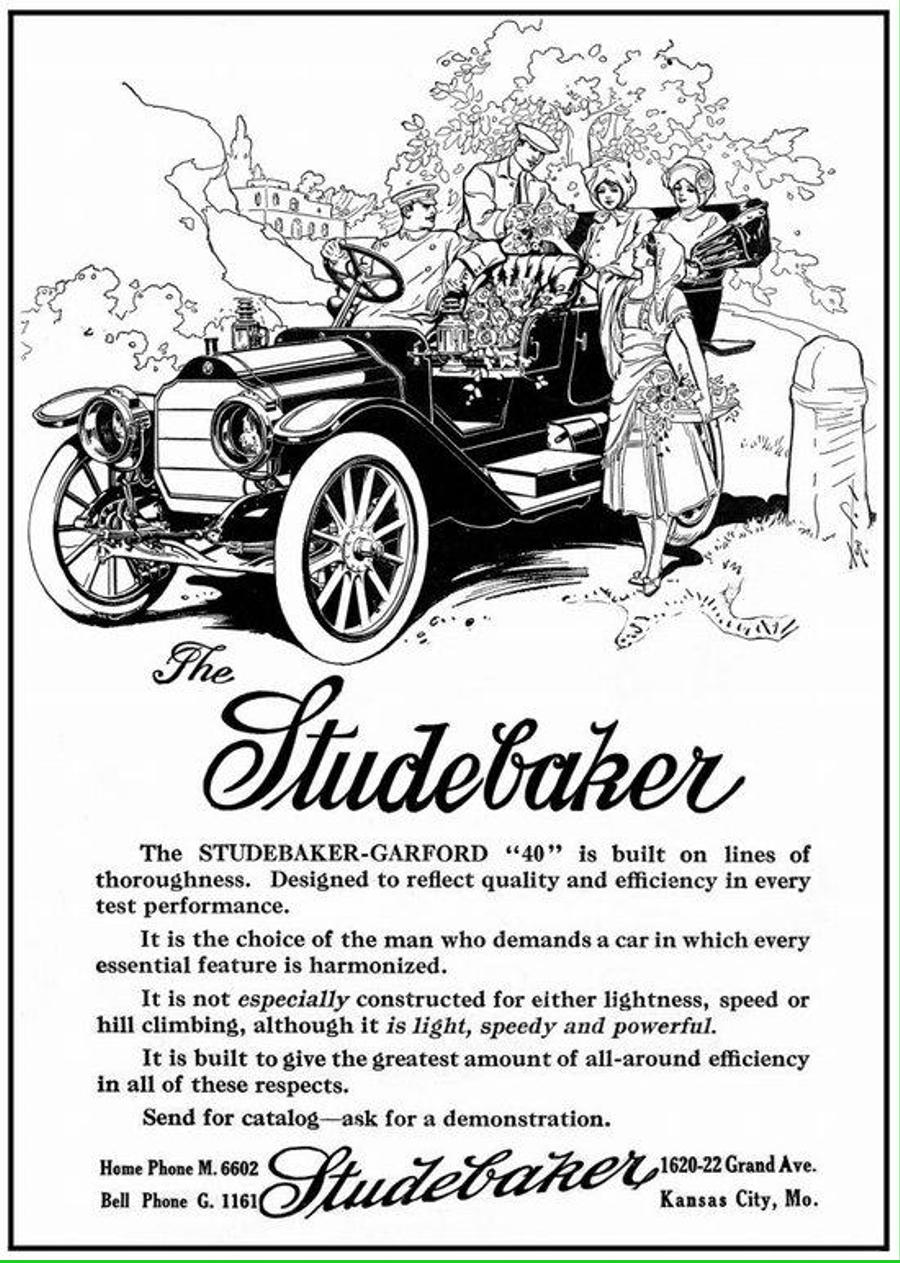
Studebaker Garford Models and Ads


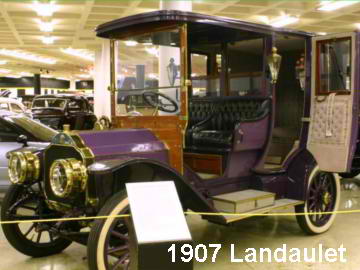
This car can be seen at the Studebaker National Museum in South Bend, IN


1909 Studebaker Garford Ad
1910 Studebaker Garford Ad
EMF Production
Unfortunately, this was not to be the case. Under the terms of the agreement, E-M-F would manufacture vehicles and the Studebakers would distribute them through their wagon dealers. Problems with E-M-F made the cars unreliable leading the public to say that E-M-F stood for “Every Morning Fix-it”. Studebaker, unhappy with E-M-F’s poor quality, gained control of E-M-F assets and plant facilities in 1910. To remedy the damage done by E-M-F, Studebaker paid mechanics to visit each unsatisfied owner and replace the defective parts in their vehicles at a cost to the company of one million US dollars. In 1911 the company reorganized as the Studebaker Corporation. In 1913, the E-M-F name was replaced with Studebaker on all new automobiles produced at the former E-M-F facilities, both as an assurance that the vehicles were well-built, and as it’s commitment to making automobile production and sales a success.
- The original contract was made in September of 1908, involved Studebaker handling only part of the E-M-F factory’s output. Specifically, Studebaker was entrusted with all of the export business and Hayden Eames, Studebaker’s general manager, was given responsibility for American South and West. Eastern sales territory was left to Metzger.
- 1909, a three year deal was signed for Studebaker to handle the entire E-M-F production capacity.
- 1909 production was 8,132 cars. This number is disputed by the New York-Herald-Tribune and the emfauto.com site which agree on 7,960.
- May 3rd, 1909 Clement Studebaker Jr. and Hayden Eames buy out Everitt and Metzger. Studebaker now controls 36% of E-M-F’s stock. Walter Flanders becomes E-M-F’s president.
- Summer of 1909 Studebaker buys the De Luxe Motor Car company assets in Detroit (for Walter Flanders). Flanders expects to manufacture a car to compete with Ford’s model T, to which Studebaker will have exclusive distribution.
- 1910, the Flanders Model 20 is introduced (see the chart below).
- 1910 production was 15,300 including EMF and Flanders. This number is disputed by the New York-Herald-Tribune and emfauto.com site which agree on 15,020
- March 9th, 1910, Studebaker buy the remaining outstanding shares of E-M-F.
- Feb. 14, 1911 Studebaker Corporation is born from the assets of E-M-F and Studebaker Brothers Manufacturing.
- 1911 production, including EMF, Flanders and a few Electrics is 22,555. This number is disputed by the New York-Herald-Tribune and emfauto.com site which agree on 26,827 not including any Electrics.
- 1912 last year production for the Flanders car. Roughly 30,000 Flanders cars were manufactured between 1910 and 1912.
- 1912, last year for the Studebaker EMF badge, production was 28,523 units.
- This number is disputed by the New York-Herald-Tribune and emfauto.com site which indicate 27,610 or 27,827 respectively. Who really knows?
- On June 20th, 2005, the old E-M-F plant on Piquette Street (at John R) caught fire and within a few hours was gone.
Most of the data below comes from the current EMF website. http://emfauto.org/index.php
E-M-F and Flanders Information.
YEAR | MODEL | SERIES | STYLE | CYL | HP | WB | Price / Production |
|---|---|---|---|---|---|---|---|
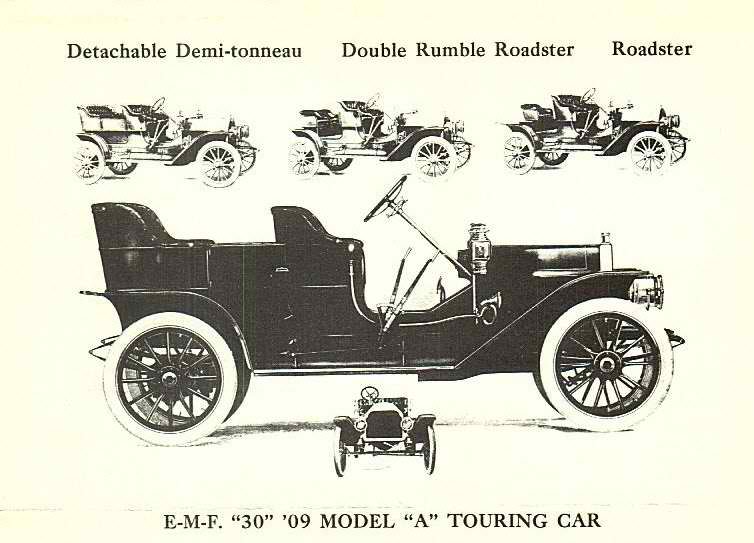
1909 | 30 | EMF | Touring, Demi-Tonneau, Roadster Single or Double, and Runabout | 4 | 30 | 106 | $1,400 / 7,960 |
1910 | 30 | EMF | Touring, Demi-Tonneau, Roadster | 4 | 30 | 108 | $1,250 / 9,417* |
1911 | A30 | EMF | Touring, Demi-Tonneau, Open Touring, Roadster, and Coupe | 4 | 30 | 108 | $1,100 / 17,194* |
1912 | A30 | EMF | Touring, demi-Tonneau, Roadster, and Coupe | 4 | 30 | 112 | $1,100 / 13,048* |
1910 | 20 | Flanders | Runabout and Touring | 4 | 21 | 100 | $750,$790 / 5,603* |
1911 | S20 | Flanders | Runabout, Suburban, Roadster | 4 | 21 | 100 | $700,$725,$925 / 9,633* |
1912 | S20 | Flanders | Runabout, Touring, Suburban, Roadster, and Closed Coupe | 4 | 21 | 100 | $775,$800,$800$750,$1,000 / 14,562* |
Production Number for EMF and Flanders *Source: New York-Herald-Tribune
| Model | 1909 | 1910 | 1911 | 1912 | 1913 |
|---|---|---|---|---|---|
EMF-30 | 7,960 | 9,417 | 17,194 | 13,048 | |
Flanders 20 | 5,603 | 9,633 | 14,562 | 909 | |
Totals | 7.960 | 15,020 | 26,827 | 27,610 | 909 |
These production totals agree with the emfauto.org site except for 1912 were their number is 27,827. With no breakdown between EMF-30’s and Flanders 20’s given. The 909 number for 1913 is not found on the emfauto.org site.
EMF Publications and Advertisements
The publication below is another 1912 EMF preliminary catlog, but this one is for the Flanders line and done by the same printing company.
Early Studebaker Racing
In these early years 1909, 1910, and 1911 there were famous races called the “The Great Savanna Races”. The race for the light cars division was called “The Tiedeman Trophy Race”.
Here are the results of that race for 1910:
This race was first run as the “Small Car Division of the International Light Car Race”, along with the Savannah Challenge Trophy. The first winner of the race was Billy Knipper in a Lancia, second place was Frank Witt in a E.M.F 30 and Costello driving a Maxwell placed third. Fourth and Fifth place were also secured by Maxwell drivers, Wright and Doorley. Knipper had an average speed of 58.44 mph, driving a total distance of 190.3 miles. Knipper’s fastest time was 17.3 miles in 17 minutes and 20 seconds. The victor won a prize of $1000. Drivers Cohen, Endicott and Knight did not finish due to mechanical failures.
Here are the results of the 1911 race:
This race was November 27, 1911 and was 10 laps on a 17.14 mile course. The drivers competing were Witt, Evans and Tower in E.M.F. 30’s, Kulick in a Ford, Roberts and Hartman in Abbott-Detroits. Witt won the race with a time of 171.40 miles in 2 hours, 56 minutes, 23.34 seconds. His average speed was 58.10 mph. Evans placed second, Tower in third, and Kulick in fourth. Roberts and Hartman did not finish their Abbott-Detroits due to mechanical failures.
As a result of the E.M.F. 30’s clean sweep of the 1911 race, Studebaker created the sales brochure shown below. Like most advertisements during this time frame, the piece seems grossly exaggerated, since we all know about the weak transaxle problems and the warranty cost Studebaker incurred in 1913 to fix past E.M.F. cars they had sold.