
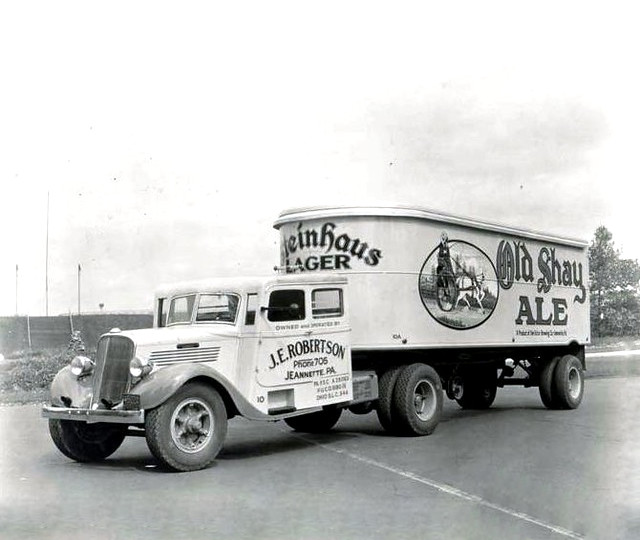
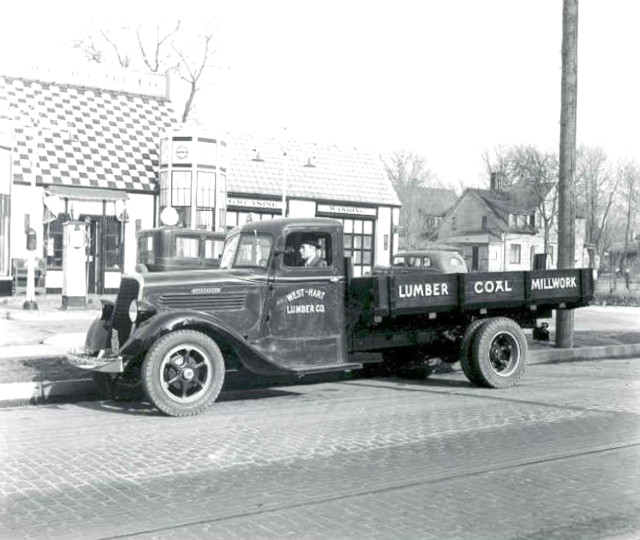
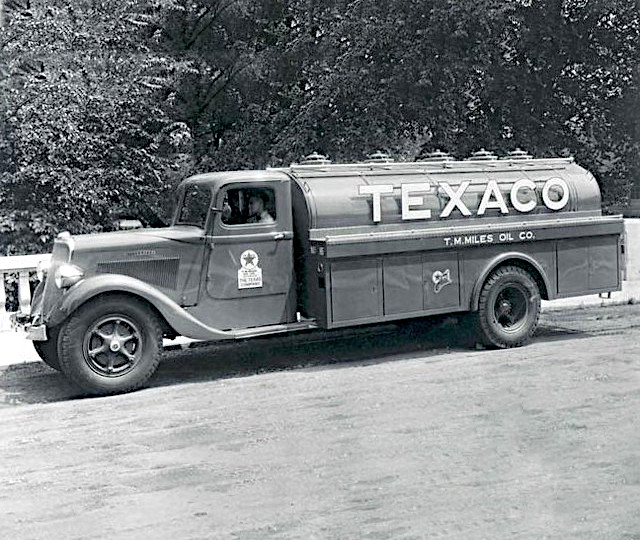
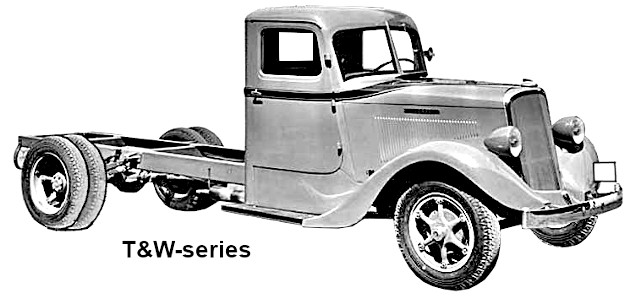
 With the introduction of the T & W Series in 1934 there is a somewhat greater commitment to stylizing the truck line and expanding the load capacity.
The first T&W series trucks 1930/1931 seems to have the vertical side hood louvers, slightly slanted forward at the bottom. Before this truck, hood side louvers had been vertical, but straight.
The trucks had new flowing front fenders with skirts, a new hood and a new slanted grille which covered the radiator for the first time. The 1934/1935 grille starts out fairly simple with a “V” shape, with a series of vertical bars on either side. In 1936 a similar grille would be more rounded and sport three sets of single horizontal bars. The 1936 trucks could be order with either the new more streamlined DeLuxe cab with a sloping two-piece windshield and contrasting color band sweeping across the hood to the doors, or use the 1932 to 1934 square cab, still available at a lower cost. This series includes the T-2 through T-8 and W-8. Beginning in March of 1934 T-series trucks would also be assembled in Walkersville Canada. 3,146 T-series were built in 1934 and another 370 were assembled in South Bend in the first few month of 1935. No trucks were built in Walkersville after December of 1934. The T trucks are Studebaker powered, where the W Series is powered by Waukesha engines (I expect that’s the merit for the “W”).
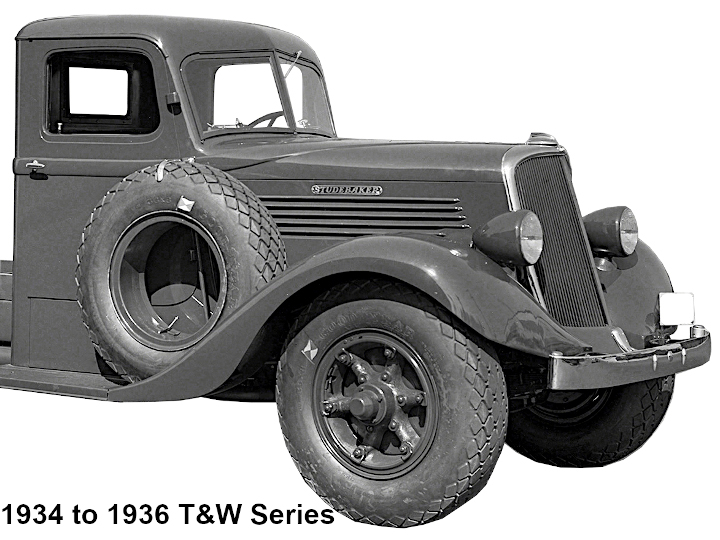
The T & W series is succeeded by a limited 1T & 1W series in March of 1935. The poor selling T4 & T8 trucks are eliminated, but a new 1W7 is added. During this time frame, these models were given names. The 1T2 was called the Ace, the 1T6 the Boss, the 1W7 the Mogal and the 1W8 the Chief (later the Big Chief).
The photo at the left has horizonal louvers and a side hood Studebaker badge which seems to be confined to the 1T & 1W trucks (1935). The wing badges are not yet present, but will start some time this same year.
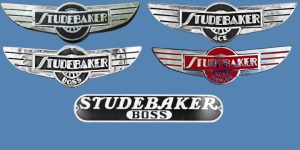
At about the middle of the year, those names would be added to the winged Studebaker emblems attached to the grille and hood sides. The trucks would only bear these names through 1936 and would not be carried on into the J-series trucks which began in January of 1937. A total of 4,005 1T/1W-series trucks are built only in South Bend from March 1935 to November of 1935
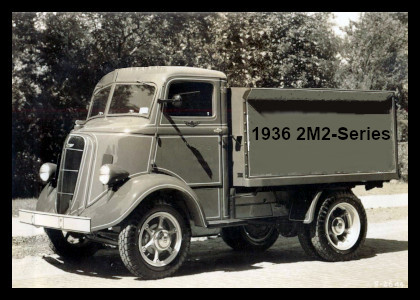
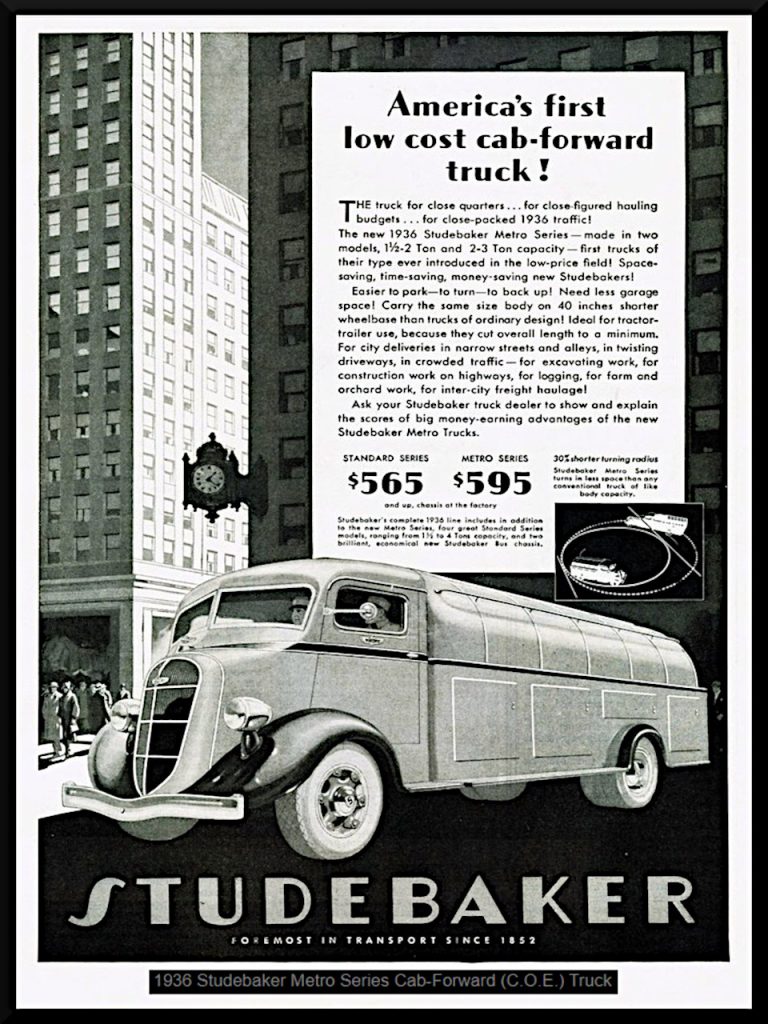
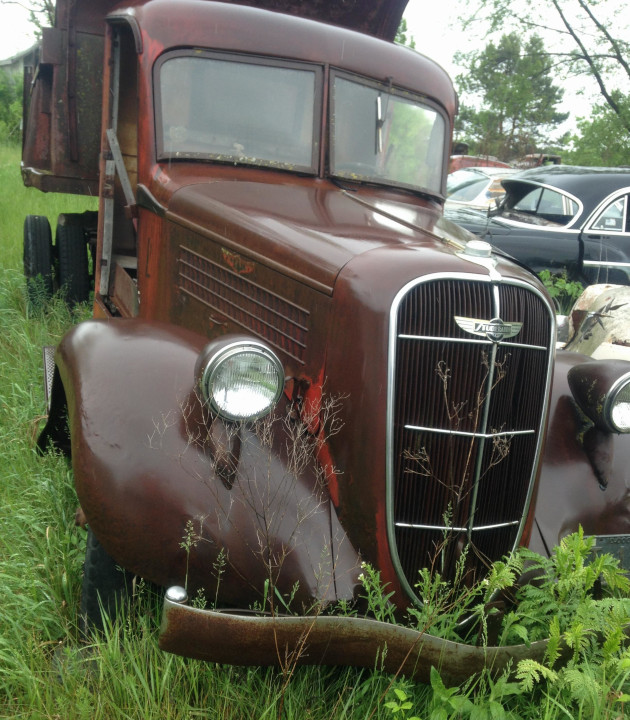 In December of 1935 the 2T & 2W series is released. These trucks would be referred to as the “Standard Series”, more on this later. These trucks got a new bumper, a more rounded grille and horizontal rather then vertical hood louvers. Only 1,981 were built from December of 1935 to April of 1937. Now the rest of the story. In January of 1936 Studebaker would get into the Cab Over Engine (COE) truck business with the release of their version they called “Cab Forward” (2M-series). They would share most of the same mechanical components as the conventional trucks, but ran on much shorter wheel bases. This line of trucks were intended for the metropolitan truck market where maneuvering in alleys and other tight spots would be easier with a shortened truck with similar payloads. Initially called “Metro”, short for metropolitan, that name was short lived as International-Harvester had a trademark on the name “Metro” and quickly let Studebaker know they would be enforcing it. Studebaker did however continue the “M” letter designation for it’s Cab-Forward trucks. The M-series trucks did fare a bit better as 2,260 2M-series trucks were built between January of 1936 to February of 1937.
Side Bar: Few M-series trucks have survived as the cabs frames were wood with steel sheathing. While the later Standards series trucks would have all steel cabs, because of low production, the M-series Cab-Forward trucks would be built as described above until the end of their production in 1940.
Tells for T,W, and M trucks:
With the introduction of the 1T&W-series the trucks were given names, the 1 1/2 ton was named “ACE”, the 2 ton “BOSS”, the 2 1/2 ton “Mogal”, and the 3 ton “Chief” (later BIG CHIEF). The named side hood badge, example shown to the left were used on 1T&1W-series. The winged badges would be used on the front of the grille and on either the side hood for “Standard” or the the doors for “Cab Forward” with the release of the 2T, 2W & 2M-series for 1936. Their use would end with the release of the J-series trucks. No truck names would be used until after the war.
With the introduction of the 1T&W-series the trucks were given names, the 1 1/2 ton was named “ACE”, the 2 ton “BOSS”, the 2 1/2 ton “Mogal”, and the 3 ton “Chief” (later BIG CHIEF). The named side hood badge, example shown to the left were used on 1T&1W-series. The winged badges would be used on the front of the grille and on either the side hood for “Standard” or the the doors for “Cab Forward” with the release of the 2T, 2W & 2M-series for 1936. Their use would end with the release of the J-series trucks. No truck names would be used until after the war.
Source: The information and photo above except where noted were extracted from a website “American Auto Emblems” by Mike Shears and his son Murray John Shears. Click the link to open it in another window, we are sure you will enjoy.
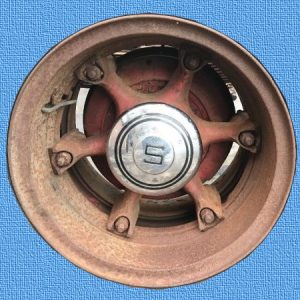
The 2T, 2W & 2M series trucks would have for the first time these larger hubcaps (left).
The Coupe Express for each year and maybe a few other commercial
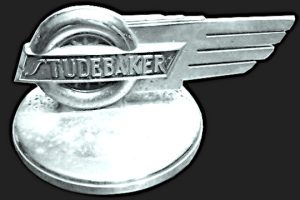
vehicles would use the car hubcaps and radiator
mascots from that year. Starting in 1936 with the 2T, 2W, 2M trucks and then also used on the J-series and K-series trucks was the “Flying Wheel” shown at the (above right).