Much has been written about the introduction of the Avanti, so there is little I could add even if I was inclined to try (which I am not). Thus for our website I will try to stick to the well known facts and time line.
February 1st,1961, Harold Churchill is ousted by the Board of Directors and replaced with Sherwood Egbert, who the board expected would accelerate the program to ease Studebaker out of the car business. He clearly had other ideas.
February, 1961, It is widely reported that Egbert’s first reaction was that Studebaker was in need of a face-lift, both in morel and physically. He set about to find a way to solve these problems by visiting a significant number of dealers, ordering the plant to be cleaned up and painted. Then he commissioned Brooks Stevens to update the Hawk and Lark lines. It has been written that Stevens was given six months and a mere $7 million to do the job.
March 9th, 1961, Egbert has invited Raymond Loewy to Studebaker headquarters. He wants Lowey to handle design work for a new high-performance halo car. It’s rumored that Egbert has a stack of clippings of sports cars that he wanted him to reference (some say a doodle on the back of an envelope). It has to be cheap, the company is cash-strapped with few resources to throw at the project, and it needs to be finished within six weeks.
March 19th, 1961, Lowey’s team has three members. John Ebstein, project manager and stellar designer. Bob Andrews will handle the modeling work. Tom Kellogg, a very young but talented sketch artist. The team will be sequestered in a very small bungalow in Palm Springs California. Design parameters are given to the team by Lowey. The layout of the vehicle has been debated, Egbert wants a two-seater, Loewy favors a 4-seat grand tourer. With no time to explore both themes, a compromise is reached. A single clay model presenting both ideas is finished on March 27th. It is taken to South Bend, Egbert is convinced to go with the GT.
Early April 1961, Randall Faurot, chief of Studebaker’s styling division, assigned Robert Doehler to transformation the one-eighth scale model into a full-size clay model.
April 27th, 1961, The full-scale clay model is finished and is presented to the Board of Directors. It is approved and work begins in earnest on transforming the model into a production car. Studebaker’s chief engineer, Gene Hardig will be in charge of the chassis development. Robert Doehler continues on the interior and exterior body development.
April 26th, 1962, Two prototype car are simultaneously unveiled at the New York International Auto Show and the Studebaker shareholders meeting in South Bend.
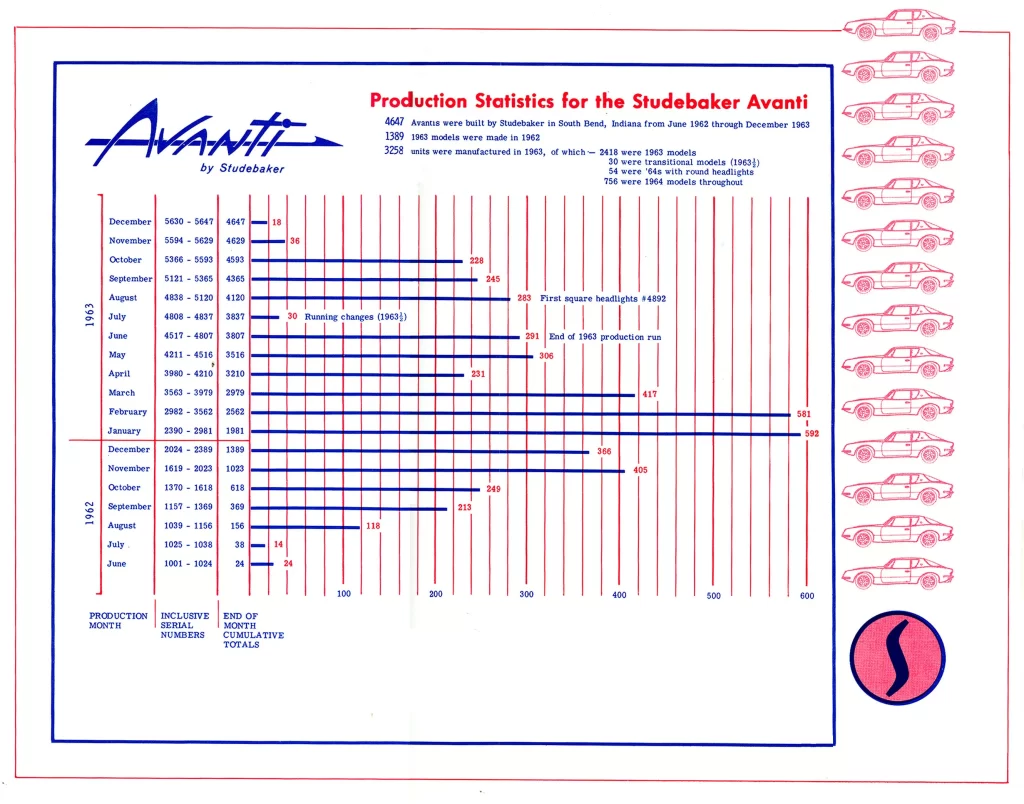
June, 1962, Actual production starts. (24) Avanti’s are built, included in this number (apparently) are the prototype cars which had been made earlier.
With all that has been written, many of the dates in the various articles are not in agreement. The dates presented here are my best effort to sort that out.
There is a great deal of Avanti information on the World Wide Web, so rather then attempt to recreate the “wheel” I will just include links to some already existing information sources.
The Fred Fox 1992 Turning Wheels Article from Bob Johnston’s website
Avanti Owners Association International
Production:
The total amount of 1963 and 1964 Avanti’s produced is widely reported at 4,647
It is also widely reported that of those, 809 were 1964 models. This would conclude that 3,838 are model year 1963. Below is production information I found on the “Studebaker-info.org” site.