
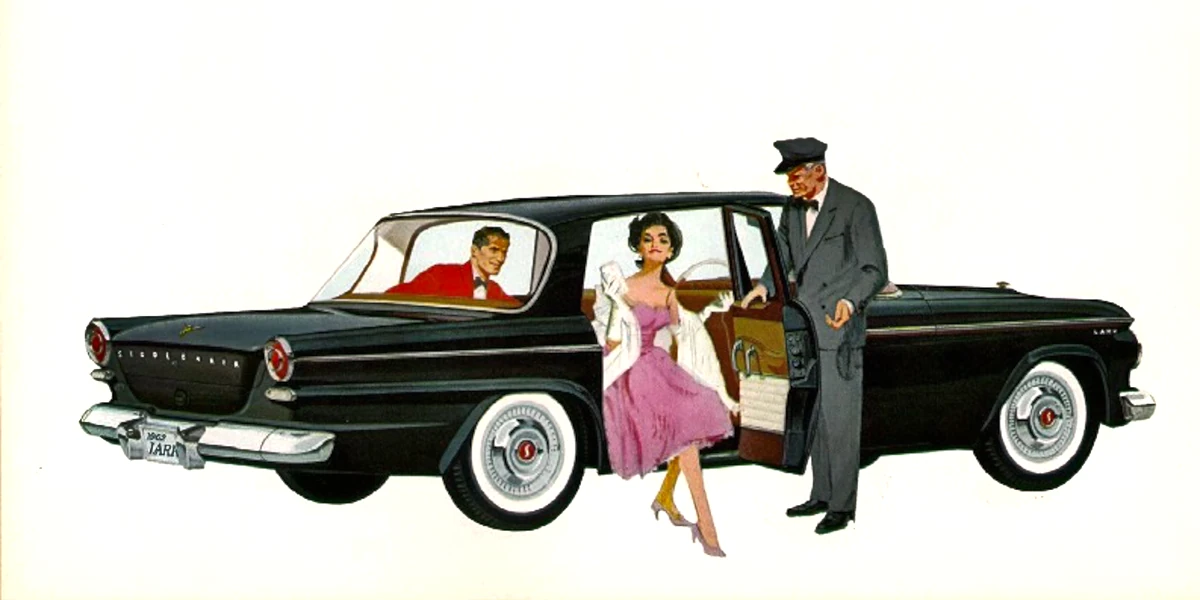
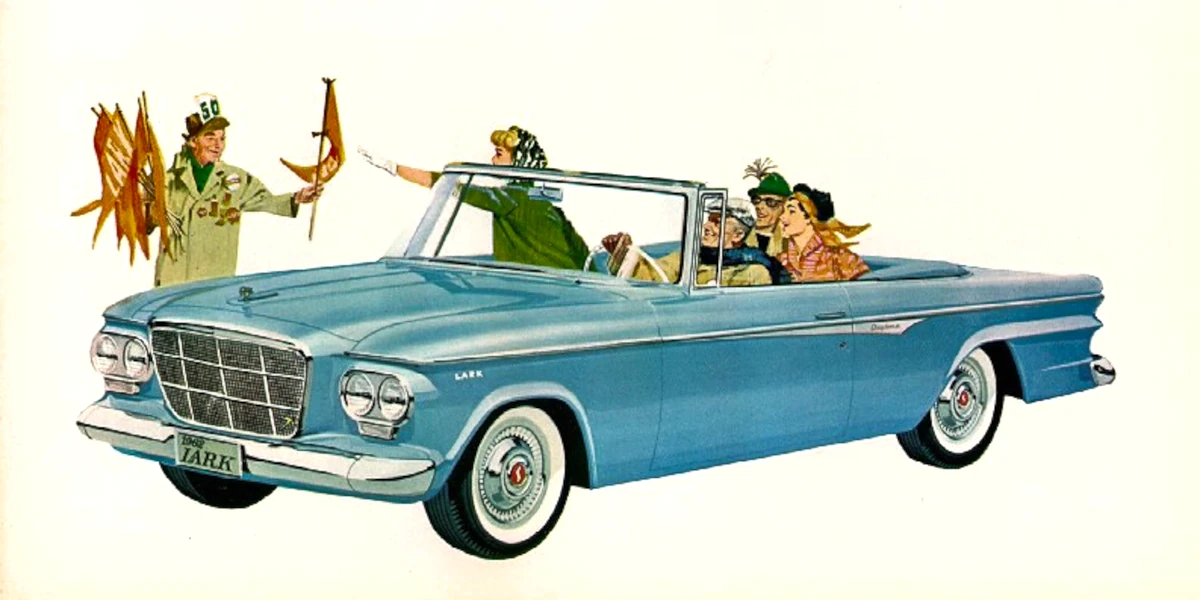
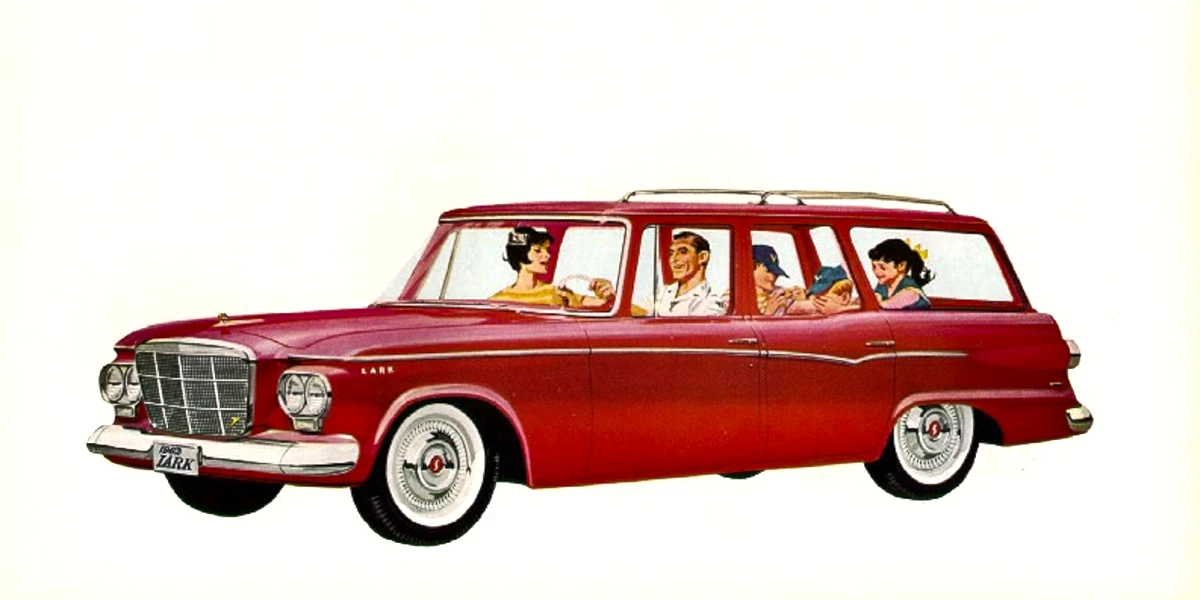
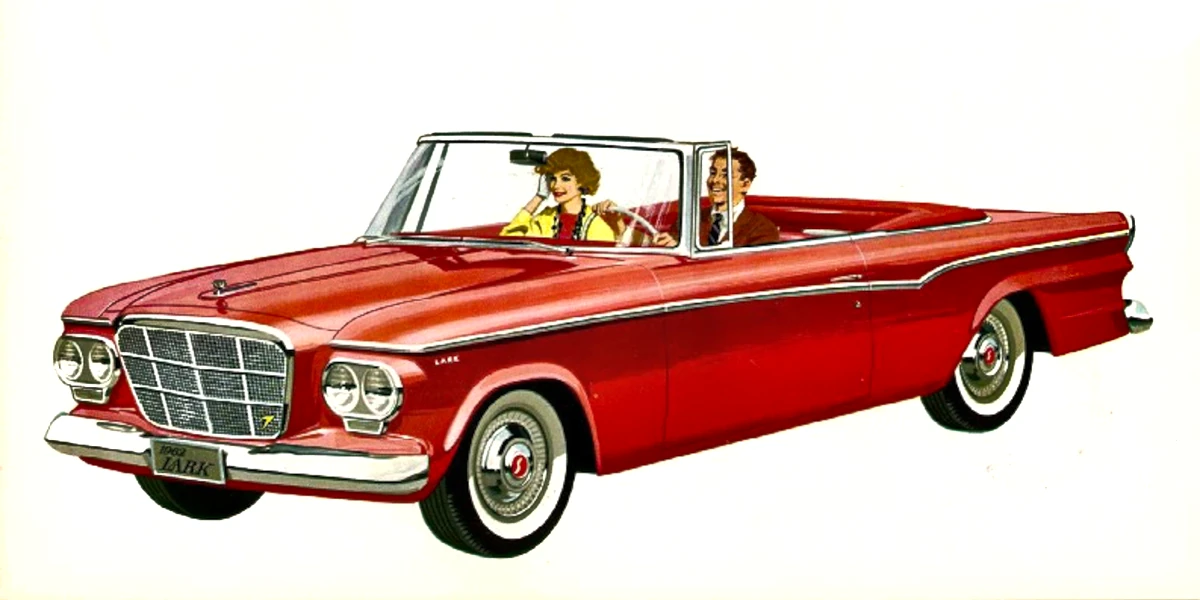
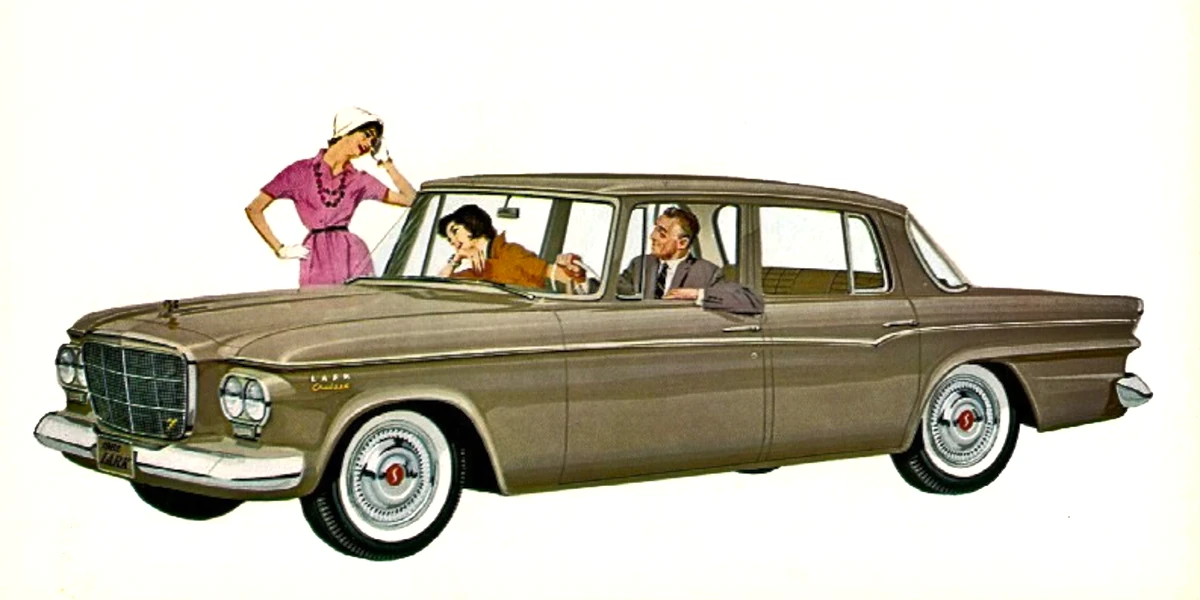
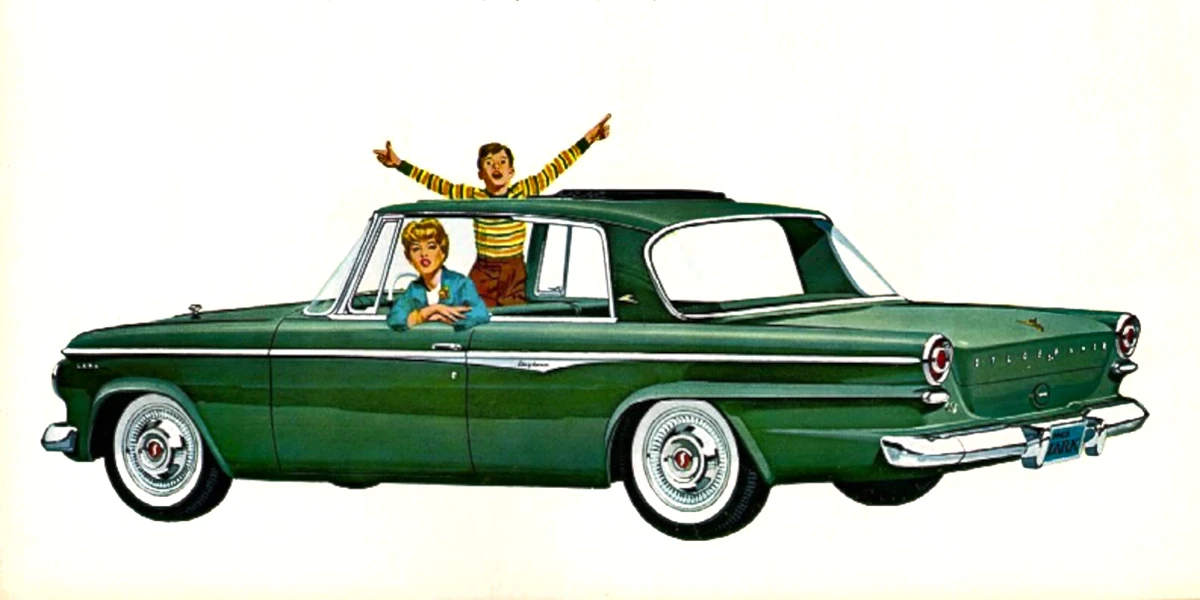
In 1960, the Lark line gets two new body styles, the Convertible and the four door Station Wagon. For 1961, a larger four door sedan, called the Cruiser is released. However, clearly that is not enough as shown in the chart below, taken from Fred Fox’s TW article (February, 1992.) We can see that Churchill’s compact strategy is not working. Pressure from the big three compacts released in 1960, AMC’s Rambler, along with foreign competition from Volkswagen has made the Lark less competitive. Something would have to be done.
1959 | 1960 | 1961 | 1962 | |
Lark Sales | 131,075 | 127,710 | 66,572 | 93,052 |
Hawk Sales | 7,788 | 4,507 | 3,924 | 9,335 |
Sherwood Egbert, cames to Studebaker from the Mcculloch Corporation, officially taking over as president of the Studebaker-Packard Corporation on February 1st, 1961.
Egbert would nearly immediately embark on a plan to make Studebaker more mid-level and more sporty. He hires and old acquaintance, Brooks Stevens to update both the Larks and the Hawks. Then he hires an old Studebaker design firm, Lowey and Associates, to create the new sports car, the Avanti. With unbelievable speed, both Stevens and Lowey would create vastly different Larks and Hawks and an all new car the Avanti.
Looking at the chart, now above (1962) we can see the immediate improvement made in sales as the result of the redesigned Larks and the GT Hawk.
Stevens’ face lifted Lark bodies, mainly because of the longer rear quarter panels and deck lid, were considerably larger than the 1959-61 models. The table below gives a good summary of the changes made.
1961 Models | Wheelbase | Overall length |
2dr models | 108.5 Inches | 175 Inches |
Reg. 4Dr sedans | 108.5 Inches | 175 Inches |
Cruisers | 113 Inches | 179 Inches |
4dr wagons | 113 Inches | 184.5 Inches |
1962 Models | Wheelbase | Overall length |
2dr models | 109 Inches | 184 Inches |
Reg. 4Dr sedans | 113 Inches | 188 Inches |
Cruisers | 113 Inches | 188 Inches |
4dr wagons | 113 Inches | 187 Inches |
Also for 1962 the Deluxe and Regal four-door sedans adopted the longer Cruiser body, but only the Cruiser had the vent doors in the rear windows. Wagons only gained a little in length because the rear quarter panels, except for the new round taillight pods, were unchanged from 1961. Other styling changes included new rear windows, new rear doors on four door sedan models and a restyled hood and deck lid. Dual headlights were standard on all models. The two-door station wagon is discontinued, but new Daytona models are released and come standard with front bucket seats with a console between them. A four-speed transmission with floor shift was optional on Daytona models. In mid-October 1961 (for 1962 Cruisers), bucket seats are made optional. The bucket seats allow room for a floor shift lever, so the four-speed is made optional on Cruisers with bucket seats.
For 1962, the 289 V8 was made an option on all Larks. When a 1962 Lark was ordered with a 289 V8, it was fitted with finned brake drums, a heavy duty model 44 rear axle, heavy duty radiator and dual exhausts. The compression ratio of sixes was reduced from 8.5:1 to 8.25:1 and V8s from 8.8:1 to 8.5:1. A generator and single chamber master cylinder were still used in 1962, but in April 1962 Studebaker switched to a standard full flow oil filter system on all models. This arrangement was an outgrowth of the full flow on filter system developed for the R1 and R2 Avanti engines.
Although not equal to1959-60, Egbert’s new sportier and roomier models made a vast improvement over 1961. The sales picture would probably have been even better if Studebaker not had to deal with a six week strike in early 1962. Calendar year corporation sales rose from $298.5 million in 1961 to 365.5 million in 1962. Profits rose slightly from $2.54 million to $2.56 million. Profits would have been quite a bit larger had it not been for the strike. It has been estimated that the strike cost the corporation $2 million.
Sadly, Studebaker’s 1962 rebound was its last. Why Studebaker could not carry on its l962 momentum into the 1963 sales year is hard to determine. Partial answers can be accredited to greater competition from the Big Three with their new sportier compacts, Egbert’s health problems, bad publicity associated with delays in Avanti production, news reports about the automotive division’s financial problems and possibly even Volkswagen’s growing market share. Discounting the inherent rust problems, the only significant quality control difficulties in 1962 were the cracked valve seats in some overhead valve six cylinder engines and non-durable pleated vinyl upholstery, but it is unlikely that these items caused any immediate loss in sales. The rest of the domestic automobile industry, including Rambler, carried on quite well in l963, so Studebaker’s problems with its automobile division cannot be attributed to financial downturns, such as those that occurred in 1933, 1938, and 1958.
Side Bar:
Also announced in April 1962 was deletion of the Packard name from the Studebaker-Packard Corporation title. It became official in July. This was a sad way for Packard to go, but none had been produced since1958 and no plans existed for its return. By name, the Studebaker-Packard Corporation survived less than eight years.
1962 Tells:


1962 and 1963 were the only Lark-types to have round tail lights, the 1962 tail lights did not have the added radial chrome lines seen on 1963 lenes. See the photo’s right and left.


 Styling changes for 1963 were quite extensive, however for the most part nearly invisble. Most of the 1963 tooling budget was spent changing the cowl design by removing the door “Dog-leg” and wrap-around windshield that had been present in the sedans, hardtop, and convertible since mid-year 1955. Fred Fox pointed out, in his TW article, that by not adopting a wraparound windshield for C/K models, Studebaker-Packard saved a lot of money, and when the Gran Turismo Hawk was introduced, its nine year old windshield styling was on the cutting edge of modern design!
Studebaker took advantage of the cowl change by switching the windshield wipers from opposing action to parallel action. Along with the new cowl comes an all new instrument panel, with a complete set of direct reading gages, gone are the idiot lights. Also new is a vanity type glove box is seen.
According to Fox, it is likely there was some debate about the front end styling. The tall boxy Lark grille was becoming dated, however it was a Lark trademark and the Mercedes-Benz sedans that Studebaker was selling featured a similar design. In the end, Studebaker continued the ’63 Lark with just a grille insert change. The big change up front would come in 1964.
 New for 1963 was an all new four-door station wagon, called the Wagonaire and designed by Brooks Stevens, it featured a rear roof section that slid under the front section. It provided many benefits, including the ability to haul tall objects, such as refrigerators and Christmas trees. The Studebaker Wagonaire model name should not be confused with the Jeep Wagoneer.
To give the 1963 Lark a lighter and more airy look, Brooks Stevens used an all new upper door design for sedan and station wagon models. This involved replacing the old thick side window frame with new thin window frame. On upper end models, such as the Cruiser, the frames and upper center door pillars are covered with stainless steel moldings, resulting in a look that gave the impression that the car was a hardtop. This treatment was not new to the industry, but was new to Studebaker.
The all vinyl upholstery used in 1962 Larks had a bad tendency of cracking along the dielectric seams. Studebaker would purchased a much more durable vinyl for its 1963 models.
1963 Lark performance options are enhanced by offering various Avanti components as extra cost options. This included R1 or R2 Jet Thrust engines, power assisted front disc brakes and a floor shift operated Powershift automatic transmission. 1963 Larks with “R” type engines came with rectangular fender badges that read “Avanti Powered” on R1 and “Avanti Supercharged” on R2 Larks.
In April 1963 Studebaker introduced the Lark “Super” High Performance Package. This offerings combined many Avanti engine and heavy duty suspension items into one package.
Other mechanical changes included (on V8s) a new Carter AFB four-barred carburetor. A new alternator, and a dual chamber master cylinder (standard on all 1963 Larks except the mid-year Standard and models fitted with the optional disc brakes). Drum brakes were again self-adjusting, a feature Studebaker had not offered since 1953. The full-flow oil filter system that was introduced in mid-1962 was continued in 1963.
1963 Tells:
1962 and 1963 were the only Lark-types to have round tail lights, the 1963 tail lights have added radial chrome lines. See the photo’s right and left.
Another quick tell, round taillights and parallel windshield wipers.
While 1962 Lark-types would feature a V8 deck lid badge, the “Six” was not identified.
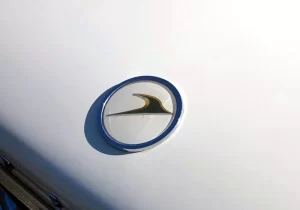
For 1963 and exclusive for this year the round badges shown below were seen on the 1963 deck lids. The 1963 grille badges shown below are also unique to 1963 Lark-type models.



Side Bar:
For reasons unknown Studebaker for the 1963 model year quit using the Deluxe name, moved Regal into it’s place and create a new line name “Custom” in the former place of Regal. Where the 4 series cars had been Deluxe they are now Regal. Where the 6 series cars had been Regal, they are now Custom. At mid-year, the new low level trim line called the Standard was introduced just below the Regal line. Next year the Regal/Custom lines would be folded into the Commander line. One might wonder if upsetting the traditional trim lines may have had a negative effect on sales?
The 1963 Standard Line-up Mid-year Introduction
Turning Wheels January 1999
Most (nearly all) of this section comes from the Fred Fox Feature Article, page 18 & 19.

Last month (TW Dec 1998) we introduced the 1963 Lark* line, compared it to the 1962 models and explained Studebaker President Sherwood Egberts great hopes for the 1963 model year. It was explained that he had made great strides in 1962, and this in a year when Studebaker and Studebaker’s employees suffered through a tough strike.
*Again, it is acknowledged that the 1963 Cruiser was not officially a Lark, but general reference, it is usually included as part of the 1963 Studebaker Lark Line.
With late model year sales of 1962 Larks and Hawks looking good, it was decided that the August 27th start-up of 1963 Lark and Hawk production would be at 80 cars per hour. This was soon adjusted to 70 cars per hour. By October 1962, Studebaker’s officials were starting to worry. Sales were not coming up to expectations. Concerning this time period, Loren Pennington wrote the following in Studebaker—Less Then they Promised: “The 1963 model was having launch troubles, and the Auto Division losses were again nearing the two million [dollar] a month level. By early November dealer orders were at 300-350 a day, no where near enough to sustain the seventy per hour rate.” What had happened? Many factors were at play, some definable, some elusive. Three major ones were the following:
As in 1956-58, many potential car buyers were well aware of Studebaker’s precarious financial position. Few people wanted to buy a potential orphan.
Although Studebaker put a lot of effort and money into upgrading the styling of the 1963 models, the results, as mentioned last month, were not that noticeable to the general public. Except for Volkswagen buyers, most Americans in the ’60s demanded that the cars they bought be “up to date” in their styling. It has often been wondered how Studebaker would have fared if they had introduced the 1964 styling in 1963.
Because of Studebaker’s low production and high overhead, it was impossible for them to be competitive-price wise with comparable compacts from the Big Three and still make a profit. Studebaker’s long time attack on the price differential was to try to build a better styled and better engineered car with more innovative features. We are the beneficiaries of this “try harder” approach, but in 1963 a dual master cylinder and a sliding roof station wagon were not enough to put the company in the black.
Think of the frustration Studebaker executives were experiencing in the fall of 1962. What to do? Still on the board of directors was Harold Churchill, Studebaker Packard’s former president. We do not have first hand information on this, but there is a good chance that Churchill proposed the idea of offering a low priced, stripped down model that could be listed under the lowest priced models offered by Chevrolet and Ford. With some success, he had done the very same thing in May 1957 when S -P introduced the Scotsman line.
Whether or not Churchill suggested it, the decision was made to bring out a low end line called the Standard. A Sales Letter (No.120, Nov. 7,1962) sent out by L. E. Minkel said that production of the Standard would start “approximately December 3.” Initially called the Lark Standard, the new line was later, in most cases, referred to as just being the Studebaker Standard. The Standard featured “`Studebaker” front fender nameplates instead of the “LARK” ones used on Daytona, Custom, Regal and Heavy Duty models. This writer remembers a TV ad, probably on the Mr. Ed show, that talked about the “all new Studebaker Standard.” The first I saw it, I expected them to show some new compact model, but instead it looked just like another Lark to me. The Standard name was certainly not as inspired as the earlier Scotsman identification, but it was a name that Studebaker had used in the past; that being the Standard Six models (ER & EU) produced in 1925-27. Evidently, someone decided that the Standard name lacked imagination, for in 1964 it was renamed the Challenger– a good name which, as it tuned out, proved to be most fitting for George Krem’s Front cover car. Actually, the Challenger name was so good that it was later picked up by Dodge and NASA.
Initially scheduled to be produced as just a two-door sedan (F2 body) and a four-door sedan (Y2 body), the line was soon expanded to include a four-door wagon (P2 body). The wagon was available with a fixed roof or an extra cost sliding roof. Both wagon versions were referred to as Wagonaires. Prior to the introduction of the Standard wagon, all Wagonaires
had come with the sliding roof feature, but soon after the fixed roof Standard wagon was announced, a fixed roof option was made available on all 1963 wagons. Studebaker’s initial idea was to mainly promote the Standard for fleet sales, but it was not long until they were pushing it in all domestic markets. The sales brochures depict this change in approach. The early Standard brochure (PD 63-49)`which did not include a wagon, had “For Budget-Minded Fleet Owners” on the front cover, while the later brochure (PD63-78), which included the wagon, had “For Budget-Minded Buyers” on the cover.
The Standard was available with the 170 0HV six, 259 V8 or 289 V8. Avanti Jet Thrust engines were not listed options, but they could be special ordered. From research completed by George Krem, we know that three Standard two-door sedans, (63V-F2) were built with Avanti Jet Thrust engines, one Rl and two supercharged R2 models. Although the Jet Thrust engines were not included in option lists for the Standard, Public Relations Director Joseph DeFranco, in a March 1963 press release said, “This engine [R2] is available as a factory option on any Studebaker-built automobile.” Unlike the Scotsman, where the option list was very limited, the Standard could be ordered with dozens of different options and accessories. As mentioned, the basic Standard was a very stripped down model. It had no side moldings, no hood ornament, no grille badge, no deck lid emblem, and no stainless steel moldings around any of the windows. Under the hood, it only had a single chamber master cylinder, although a dual master cylinder was available as an extra cost option. On the interior, only bench seats were available and the fancy vanity glove compartment gave way to just a box with a lid on top. Because the Standard had no grille or deck lid emblems, there was no way from the outside to easily tell if it was a six or V8.
Since we are still lacking detailed production figures for most 1963 models, we have no idea how well the Standard models sold, but we do know that quite a few have survived. Like many 1959 Scotsman pickup owners, most people who owned 1963 Standards in the past had no idea what the correct name for their car was. On the other hand, most current owners of Standards who belong to SDC know what their car is and enjoy pointing out its special features.
1963 Compacts
One goal Studebaker had for the Standard was to have it competitively priced when compared to the other domestic compacts. Here is how it stacked up.
(Prices given are for base model two-door six cylinder compacts.)
Rambler American 220 | $1,846 |
Plymouth Valiant V-100 | $1,910 |
Studebaker Standard | $1,935 |
Ford Falcon | $1,985 |
Corvair 500 | $1,992 |
The Studebaker Standard was certainly competitively priced,but it was also being produced by a company that was essentially losing money on every car it assembled. Only higher production, which Studebaker hoped the Standard would help achieve, would put the company in the black.
Domestic Upholstery Materials: 1963 Larks

Standard (F2, Y2 & P2)
Standard: Blue, Green, Chestnut or red plain & textured vinyl
Optional: Blue, Green, Chestnut or red heavy duty plain vinyl
Note: The optional heavy duty vinyl cost an extra $15.00
Regal (F4, Y4 & P4)
Standard (except wagon): Blue, Green, Chestnut or Red striped Nylon cloth inserts and vinyl capping.
Optional (standard on wagon): Blue, Green, Chestnut or Red plain and textured vinyl.
Note: The optional all vinyl was $13.00 extra on Regal sedans. The optional heavy duly vinyl cost an extra $15.00.
Custom (F6 & Y6)
Standard: Blue, Green, Chestnut or Red pleated textured cloth inserts and vinyl capping.
Optional: Black, Blue, Green, Chestnut, Red or Tan pleated vinyl capping and white pleated vinyl inserts.
Optional: Matching color pleated vinyl inserts for the above all vinyl upholstery.
Note: The optional all vinyl pleated upholstery, with white or matching inserts, cost an extra $31.74.
Daytona (J8, L8 & P8)
Standard on hardtop: Blue, Green, Chestnut or Red pleated Nylon cloth inserts and pleated Vinyl capping.
Optional (Standard on convertibles and wagons): Black, Blue, Green, Chestnut, Red or Tan pleated vinyl capping and white pleated vinyl inserts.
Optional: Matching color pleated vinyl inserts for the above all vinyl upholstery.
Note: The optional all vinyl pleated upholstery with white or matching inserts, cost on extra $31.74 on hardtop models.
Cruiser (V8)
Standard: Blue, Green, Chestnut or Red pleated Nylon cloth inserts and pleated vinyl capping.
Optional: Black, Blue, Green, Chestnut, Red or Tan pleated vinyl capping and white pleated vinyl inserts.
Optional: Matching color pleated vinyl inserts on the above all vinyl upholstery.
Optional (not available with bucket seats): Blue, Green, Chestnut or Red buttoned and wide pleated Broadcloth.
Note: The optional vinyl pleated upholstery, with white or matching inserts, cost an extra $31.74. The optional Broadcloth cost an extra $72.00.
Taxicab(Y1)
Standard: Blue, Green, Chestnut or Red heavy duty plain vinyl.
Heavy Duty (F3, Y3 & P3)
Standard (except wagons): Blue, Green, Chestnut or striped Nylon cloth inserts and vinyl capping.
Standard (wagons): Blue, Green, Chestnut or Red plain and textured vinyl.
Optional: Blue, Green, Chestnut and Red. heavy duty plain vinyl.
Note: The optional heavy duty vinyl cost an extra $15.00.
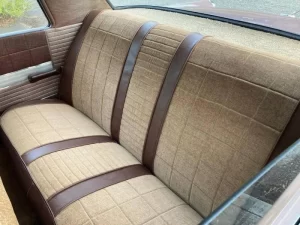
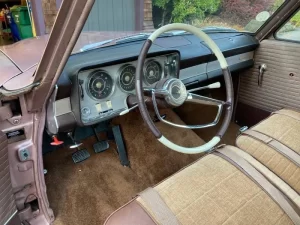
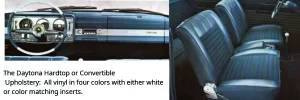
Shown to the right and left (front and rear seats) is a Custom Model 4-door sedan with standard (pleated cloth) that the seller indicates was redone with NOS upholstery?
Upholstery Codes
Studebaker used the following letter codes for its 1963 Lark upholstery materials.
BC | Blue cloth inserts and vinyl capping |
GC | Green cloth inserts and vinyl capping |
CC | Chestnut cloth inserts and vinyl capping |
RC | Red cloth inserts and vinyl capping |
BKV | Black vinyl (white or matching inserts on Custom, Daytona and Cruiser models) |
BV | Blue vinyl (white or matching inserts on ‘Custom, Daytona and Cruiser models) |
GV | Green vinyl (white or matching inserts on ‘Custom, Daytona and Cruiser models) |
CV | Chestnut vinyl (white or matching inserts on ‘Custom, Daytona and Cruiser models) |
RV | Red vinyl (white or matching inserts on ‘Custom, Daytona and Cruiser models) |
TV | Tan vinyl (white or matching inserts on ‘Custom, Daytona and Cruiser models) |
BBC | Blue Broadcloth (Cruiser only) |
GBC | Green Broadcloth (Cruiser only) |
CBC | Chestnut Broadcloth (Cruiser only) |
RBC | Red Broadcloth (Cruiser only) |
Note: The matching colored vinyl inserts are listed as item 14A on window slickers and production orders. | |
In addition to the letter codes, a three for four digit number code was used for 1963 Lark upholstery identification.
First Digit | |
0 | Standard models with all vinyl |
1 | Standard, Regal and Heavy Duty models with heavy duty all vinyl |
2 | Taxicabs with heavy duty all vinyl |
4 | Regal and Heavy Duty models with cloth and vinyl |
5 | Regal models and Heavy Duty wagon with all vinyl |
6 | Custom models with cloth and vinyl |
7 | Custom models with all vinyl |
8 | Daytona hardtop and Cruiser with cloth and vinyl, and Cruiser with Broadcloth |
9 | Daytona and Cruiser with all vinyl |
Second Digit | |
0 | Red Broadcloth |
1 | Black upholstery |
2 | Blue upholstery except Broadcloth |
3 | Green upholstery except Broadcloth |
4 | Chestnut upholstery except Broadcloth |
5 | Red upholstery except Broadcloth |
6 | Tan, upholstery |
7 | Blue Broadcloth |
8 | Green Broadcloth |
9 | Chestnut Broadcloth |
Third Digit | |
2 | Two-door sedan |
5 | Four-door sedan |
7 | Four-door wagon |
8 | Convertible |
9 | Hardtop |
Fourth Digit (Custom, Daytona and Cruiser models with all vinyl upholstery)
No 4th digit…white vinyl insert
1 as the 4th digit …Matching color vinyl inserts.
The upholstery code is listed adjacent to item #14 on 1963 window stickers and production orders. For instance, a 9281 BV upholstery code means the following:
9 | Daytona and Cruiser with all vinyl |
2 | Blue upholstery |
8 | Convertible |
1 | Matching color vinyl inserts |
Since the Cruiser was not built as a convertible, we know that 9281 represents a Daytona convertible with (BV) blue vinyl capping and (forth digit 1) matching blue vinyl inserts.


Exterior:
For the 1964 model year, Studebaker would continue to move away from using the term “Lark”. The Lark badging would be removed from all 1964 models and only used by sales in conjunction withbut the newly release Challenger (the replacement for the former Lark Standard) and the Commander (replacement for Custom/Regal).  The Lark emblem used on the 1962/63 Daytona’s would be seen only on the side of the rear roof panel on the Challenger. All 1964 Studebakers were promoted as being “Different…..by Design”
Brooks Stevens did a remarkable job of morphing the 1963 Lark into a 1964 Studebaker line-up. New sheet metal was used on the front fenders, hood, deck lid, and a sculptred roof panel. Also, new are the circle “S” hood ornament (an accessory on the Challenger), wrap around bumpers, wheelcovers, new horizontal tail and backup lights (on sedans and hardtops) and a new grille. Sedans and hardtops were also fitted with a near flat new rear window.
The new wide keystone grille was fitted with single headlights (duel optional) on Challengers and Commanders, while duel headlights were standard on Cruiser, Daytona and Wagonaire. The parking lights have white lens with amber bulbs. Challenger, Commander, Daytona, and Cruiser had their respective script names placed on the front fenders. Challanger and Commanders had script “Studebaker” on the back while Daytona and Cruiser models used block “Studebaker” letters. Challenger and Commander have one crome strip across the back of the deck lid while Cruiser and Daytona would sport three strips, plus a two piece wide metal bright metal overlay. Challenger has no side trim, Commanders have one narrow strip, Cruiser and Daytona would sport a wider bright and black strip. The Daytona strip has a black center while the Cruiser has a black outline.
 V8 Models have a chevron front fender badge with an “8” in the center, however there was no “Six” engine badge. All Avanti powered Super Larks used the oval “R” side badges and the round “R” grille badges associated with what ever “R” type engine was installed.
 Each model has it’s own distinct rear sail panel badge, with Challanger using the old “Lark” badge (shown above),
  Commanders using the cirlce “S”, Daytona using the V8 emblem with racing flags, and
  Cruiser has a horizonal trim strip with 15 black slash marks. Cruiser continued with the rocker panel trim and now also has small rear fender stone shields.
The “Skytop” sunroof option is gone. The fixed roof option is available on all Wagonaire models (sliding is standard). Last years Regal, Standard, and Custom names are gone as well. The Daytona is available only as a V8 in the US. The Challenger name is new and Studebaker has brought back the Commander name, last used in the 1958 model year.
Tells: For sedans and hardtops, the nearly flat rear window. The distinctive name badges on the front fenders. Also, the first year Lark-types would wear the Circle “S” hood ornament. Clearly Studebaker was moving back toward Model Types and away from the “Lark” signature.
Interior:
The 1964 Studebaker interior was little changed from last year. The glove box door was smaller, the Beauty Vanity (now available as standard only on Cruiser and Daytona) is rest
yled and there is a new instrument background plate. The horn button now sports the “S” in place of the former “Lark” emblem and the parking brake is changed from the pull type to a foot operated version. Upholstery is similar to 1963 with a few new cloth patterns and some different vinyl grains. The all-vinyl selections for Cruiser and Daytona would no longer offer the white inserts.

Upholstery Materials 1964 Lark-types
Challenger | Color | ||
Standard/Vinyl | Blue | Green | Brown |
Optional (on sedans)/Cloth | Blue | Green | Brown |
Note; Optional cloth was an extra $24.00 | |||
Commander | Color | ||
Standard/Cloth (except Wagonaire) | Blue | Green | Brown |
Optional/Vinyl (standard on Wagonaire) | Blue | Green | Brown |
Note; Optional vinyl was an extra $13.00 | |||
Daytona | Color | |||
Standard/Cloth (except convertible & Wagonaire) | Blue | Green | Brown | Red |
Optional/Vinyl (standard on convertible & Wagonaire) | Blue | Green | Brown | Red |
Note: Optional vinyl was an extra $31.74 on hardtop and sedan. The black vinyl was discontinued after January 1, 1964. | ||||
Cruiser | Color | |||
Standard/Cloth | Blue | Green | Brown | Red |
Optional/Broadcloth | Blue | Green | Brown | Red |
Optional/Vinyl | Blue | Green | Brown | Red |
Note; The broadcloth was an extra $72.00. The vinyl was an extra $31.74. After January 1, 1964 the following was discontinued: Green and Red Cloth. Green and Red Broadcloth, Information is inconsistent on whether or not the Cruiser Vinyl option was continued after January 1, 1964. | ||||
Upholstery Codes
Studebaker used the following letter codes for its 1964 upholstery materials:
| BV = Blue Vinyl | GV = Green Vinyl | BRV = Brown Vinyl | RV = Red Vinyl |
| BC = Blue Cloth | GC = Green Cloth | BRC = Brown Cloth | RC = Red Cloth |
| BB = Blue Broadcloth (BLB in Canada) | GB = Green Broadcloth (not available after 1/1/64) | BRB = Brown Broadcloth | RB = Red Broadcloth (not available after 1/1/64) |
| BKV = Black Vinyl |
In addition to the letter codes a three digit number code was used for 1964 upholstery identification:
| First Digit | |
| 1 | Heavy Duty/Marshal heavy duty vinyl |
| 2 | Taxicab heavy duty vinyl |
| 4 | Challenger cloth |
| 5 | Challenger vinyl |
| 6 | Heavy Duty/Marshal and Commander cloth |
| 7 | Heavy Duty/Marshal and Commander vinyl |
| 8 | Daytona and Cruiser cloth |
| 9 | Daytona and Cruiser vinyl |
| Second Digit | |
| 1 | Black |
| 2 | Blue |
| 3 | Green |
| 4 | Brown |
| 5 | Red |
| Third Digit | |
| 1 | 4dr Sedan (except Cruiser) |
| 2 | 2dr Sedan |
| 5 | Cruiser |
| 7 | Wagonaire |
| 8 | Convertible |
| 9 | Hardtop |
The upholstery code is listed adjacent to item #14 on 1964 production orders.
For instance, a 915 BKV code is decoded as follows:
9 = Daytona & Cruiser vinyl
1 = Black [upholstery]
5 = Cruiser
BVK = Black Vinyl
A 442 BRC code is decoded as follows:
4 = Challenger cloth
4 = Brown [upholstery]
2 = 2dr Sedan
BRC = Brown cloth
Engine Numbers 1964 Lark-types
Studebaker adopted an all new engine numbering system in 1964. An explanation of the code follows. The oddity of the system was that any given engine type built on the same day and not exported from North America had the same engine number. For instance, a Cruiser has engine number PK321. As will be explained, this number indicates that this Studebaker Cruiser has a 289 V8 that was built on October 21, 1963. It turns out that any regular 289 V8 that was built on the same day and fit into a domestic Lark-type vehicle or Hawk will have the same engine number.
Engine Identification for 1964 Lark-types Models
The following symbols identify the engine type and are the prefix of the 1964 engine number:
Symbol | Engine | Car Manufacturing Site |
S | 170 Six | South Bend |
V | 259 V8 | South Bend |
P | 289 V8 | South Bend |
JT | 289 Jet Thrust V8 | South Bond |
JTS | 289 Jet Thrust Supercharged V8 | South Bend |
SC | 170 Six | Hamilton |
VC | 259 V8 | Hamilton |
PC | 289 V8 | Hamilton |
JTC* | 289 Jet Thrust V8 | Hamilton |
JTSC* | 289 Jet Thrust Supercharged V8 | Hamilton |
*Although these are listed in Studebaker sources, there is no evidence that any Of these engines were produced.
Following the symbols in the table above, is a code letter that indicates the month the engine was built.
A-Jan | E-May | J-Sept |
B-Feb | F-June | K-Oct |
C-March | G-July | M-Nov |
D-April | H-Aug | N -Dec |
Note: The letters I and L were not used.
After the month code is the year code; “3” for 1963 and “4” for 1964.
After the year code is the date of the month
Thus for engine: PK321

Engines exported from North America were given a suffix to the engine number that indicated it was the nth export engine built on that day. For instance, if the engine number above was followed by a 14, it would mean it was the 14th export 289 V8 built on October 21, 1963.
Engine Number Locations:
Six-cylinder engines: stamp on a boss at the top, left side, front corner of the cylinder block,
V8 engines: stamped on a boss at the top side front end of the cylinder block.