
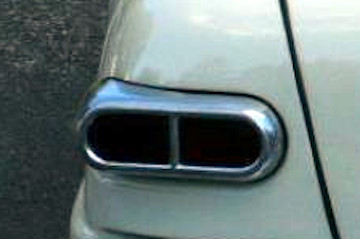
 To the left “Champion”
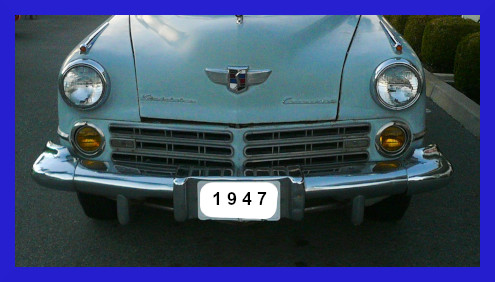
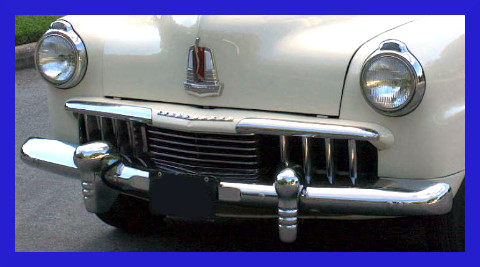
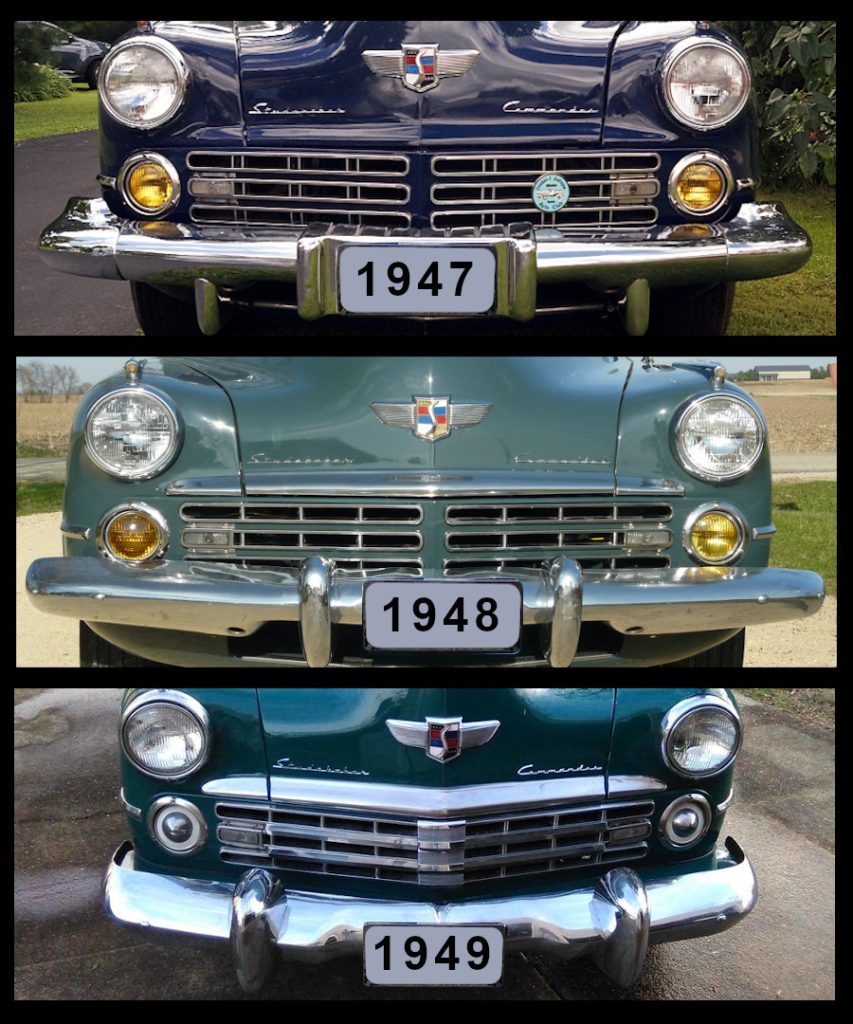 How to tell what year Commander?
1947 Commander:
“First By Far With a Postwar Car”, that’s the slogan for 1947. However, Kaiser-Frazer is actually the first post war car displayed, January 20th, 1946 at the Waldorf Astoria Hotel in New York City. The cars displayed however were just prototypes and actual production did not start until June of 1946, by then Studebaker had been delivering new 47’s to dealers and customers for at least a month or more, making Studebaker’s claim quite valid.
The 1947 design actually starts during the war year. This could happen because the design work was being provided by an outside firm, not subject to the war time rules for in house automotive work. The firm of course is Loewy and Associates. The South Bend studio is headed by Virgil Exner, who would make his greatest mark, later at Chrysler doing the “Forward Look” designs. Working under Exner are some of the greatest stylists ever assembled. Gordon Beuhrig (Coffin-nosed Cord & Auburn Speedster), Robert Bourke (1953 Studebaker), Holden Koto (1949 Ford), and John Reinhart (1956 Lincoln Continental Mark II).
By 1943 most of the parameters of the post-war design have been established. However, it is about this time when Exner and Lowey began to quibble about design recognition. The details are to great to cover here. But, suffice to say, Exner departs in early 1944 and Gordon Beuhrig becomes Lowey’s new head guy. Then, Studebaker’s chief engineer Roy Cole , no fan of Lowey, hires Exner to continue design work on the sly at his home. This set the stage for two competing designs to evolve. Now, the shenanigans really start. Cole gives Beuhrig exterior dimension limitations which are much smaller then the ones given to Exner. When Lowey makes his presentation to the Board, he is told his prototype is to small, thus Lowey’s project is delayed and eventually the Board selects Exner’s secret design. Lowey is understandable upset and to pacify him Studebaker gives Lowey one hundred percent credit for the new design, thus robbing Exner and Cole of the very recognition they were trying to achieve.
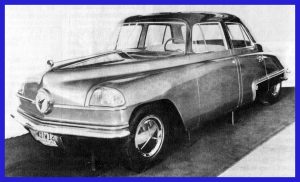 Early mock-ups were of a slab-side design like the Kaiser-Frazier and some consideration was also given to a possible rear mounted engine. As rear engine drive and slab-side designs were eliminated, slightly protruding bolt-on rear fenders appeared. Thus, avoiding the upside-down bathtub look of the Ford, Hudson, Packard, and Nash. Chrysler and General Motors post-war designs would look much like Studebaker’s side treatment. Exner’s main influence would be from the cowl forward where he favored the square front treatment, as opposed to Beuhrig’s sloping hood design, that would eventually appear in 1952.
Model Line-up:
The 1947 model line-up includes two Sedan’s, (two-door and four-door). Business Coupe (3-pass), a new Coupe (5-pass). A a new Convertible. The convertible was not available in the initial run. Two prototype station Wagons were built, but never put into production. Only in the Commander line, would be a Land Cruiser “Y Body” 4-door Sedan.
The new coupe had a rear window made from four separate curved glass sections, which wrapped around the rear of the car, nearly to the doors. Initially named “5-passenger coupe”, it would become the “Starlight” coupe in 1949 and today that name is generally applied to all coupes of that design. An interesting accessory, only available to “Starlight” coupes, often appears on these cars, “Venetian Shades” (AC-1542).
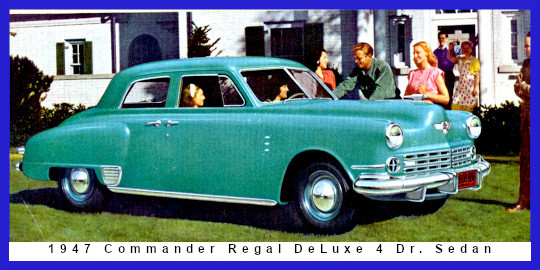
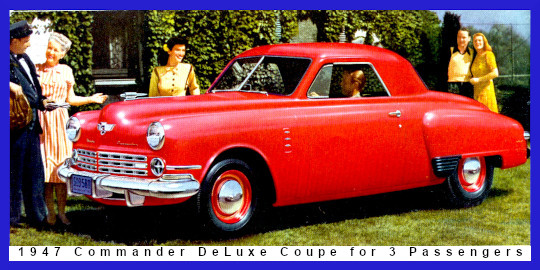 I was unable to find a two door Sedan photo example. Two trim levels are available, DeLuxe and Regal DeLuxe, the Convertible and Land Cruiser would only be available in Regal Deluxe trim. Regal DeLuxe is identified by stainless body sill (rocker panel) moldings, stainless windshield reveal molding, and stainless steel gravel guards, not seen on DeLuxe models. Also, Regal DeLuxe interiors have better appointments. The Starlight coupe, Convertible, and Commander Land Cruiser have a single piece curved windshield, while the sedans and the business coupe have the conventional two part flat glass. The major visual difference between Commanders and Champions is the grille, tail light, and bumper design. Commander’s also running on a seven inch longer wheel base (119) and are 13 ½ inches longer (all from the cowl forward), then a Champion. The “Commander Land Cruiser” is even longer, running on a 123 inch wheel base with four inch longer rear doors and an additional four inches grafted into the body to accommodate those longer doors.
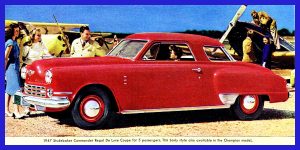
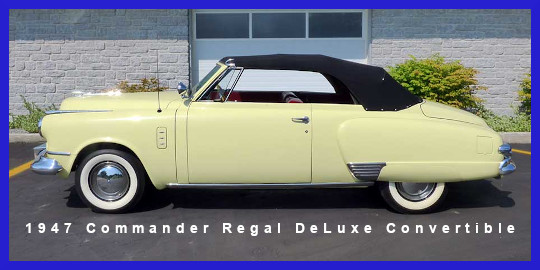 The 1947 is an all new car design and as such some rather unique design features came along for the ride. One of those was the “Black Light” instrument panel lighting, developed during the war for aircraft. The lighting was via panel bulbs that only put out UV light, which in turn made the instrument pointers and markings glow as these were painted with fluorescent paint. These marking would continue to glow for sometime even after the lights had been turned off. Studebaker would use this lighting system through 1952. The Commander and Champion had similar but different instrument panels but are easy to identify as both have name badges on the right side of the three round dials and radio grille.
Tells:
The all new 1947 cars have pontoon rear fenders with tail lights mounted to them, much different then the 1946 Skyway tail lights, that while horizontal, were mounted to the rear body section, not the fender. Skyway’s had a massive grille with horizontal thin bars, while the new Commander’s have three chrome trimmed slots with round ends, on each side of the car. Also, there was no Commander’s in the shortened 1946 model-year.
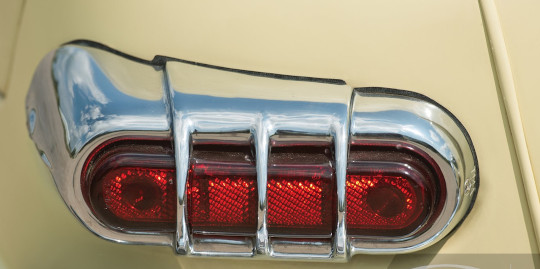
Commander’s have three horizontal chrome ornaments on the vent doors which Champions do not have. Commander taillights are divided into four segments by the chrome taillight bezel, Champion’s only have two segments.
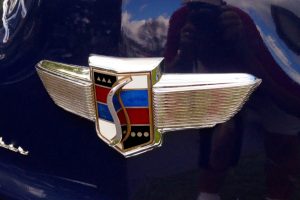
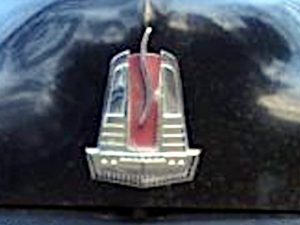
The Commander hood emblem has wings on either side (left) which are missing from the Champion badge (right).
Commander parking lights are placed in the grille where Champion parking lights are built into the headlight ring. Commander Land Cruiser is the only model with a rear door wing window.
Mechanical:
New frames are designed for the 1947 cars, along with self-adjusting and self-centering brakes. A two-section propeller shaft is designed and would be used through 1957. The engine is moved forward, allowing the back seat to move to a location in front of the back wheels, making for a much better ride. Removable rod bearing are used. A new one year only vacuum pump driven by the oil pump drives the windshield wipers on the Commander. 15 inch wheels are used on both the Commander and Champion, the Champion’s has four studs and Commander has five.
Sidebar:
The rims used on the Commander’s from 1947 to 1950 and on all post war ½ ton pick-ups had a 5” pitch diameter. Car rims after 1950 have a 4 ½ inch pitch diameter, thus are not interchangeable.
1Sidebar on the convertible upholstery and flooring:

1948 Commander:
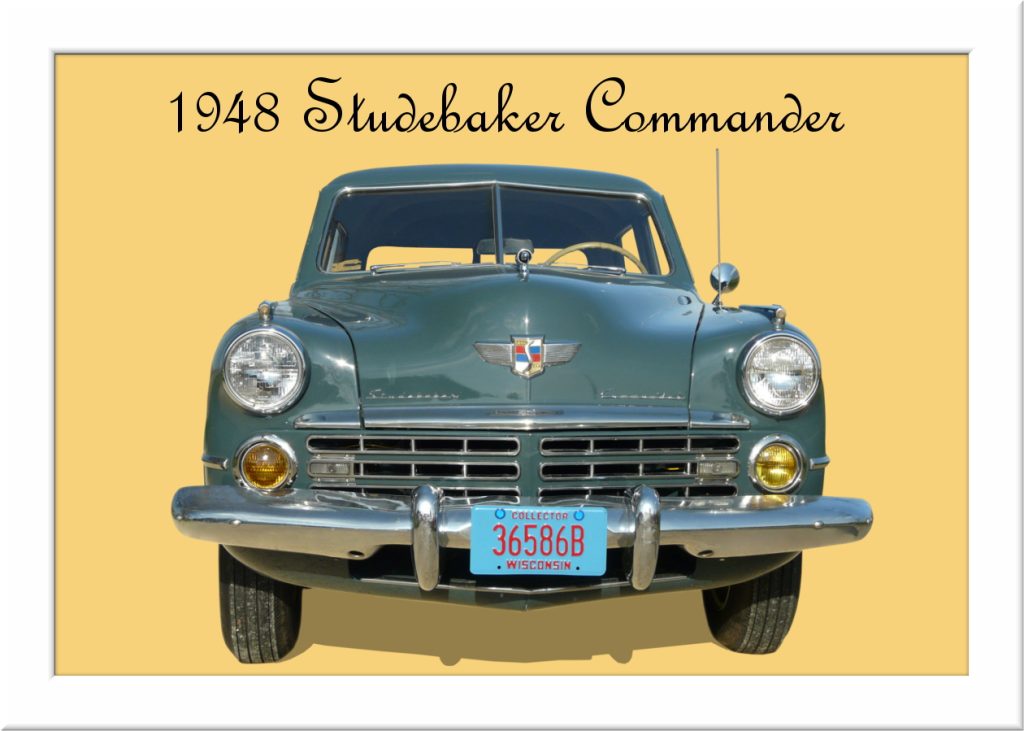 On the exterior the only change is adding a new chrome strip to the bottom edge of the hood, extending on both fenders just above the grille and eliminating the one piece license plate holder in favor of two new bumper guards that now extend above and below the bumper. It does not seem that any interior changes were made.
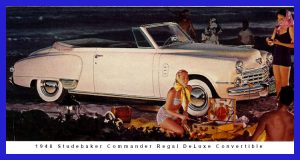 The 1948 model line-up is similar to 1947 and includes two Sedan’s (two-door and four-door) and the 5-passenger Coupe. All three models would come in DeLuxe and Regal DeLuxe trim. For Regal DeLuxe trim only, a Convertible and Land Cruiser 4-door Sedan is available. Gone are the Business coupes (Q1 & Q2), however there is evidence that one Regal DeLuxe (Q2) Coupe was manufactured in LA.
1949 Commander:
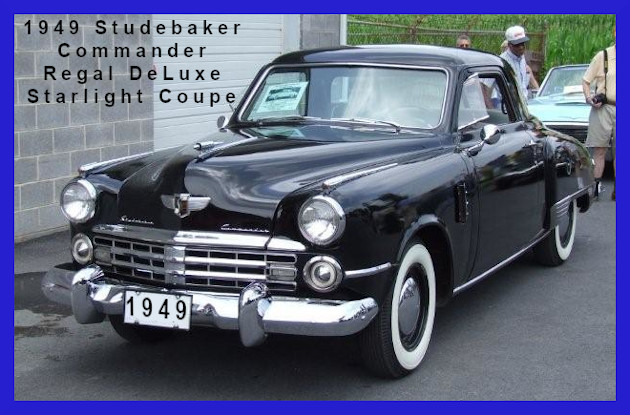 Exterior changes involve the grille and the bumpers. The Commander grille gets new chrome moldings between the grille slots and a new rectangular center trim piece, to brighten up the front end. The front fender top ornaments, which had been extra cost items, are now standard equipment. The new front and rear bumpers wrap around to the side of the cars. The bumper guards increase in size and move farther outboard on the bumper.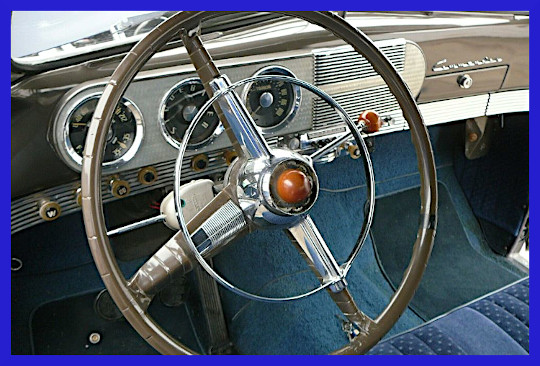
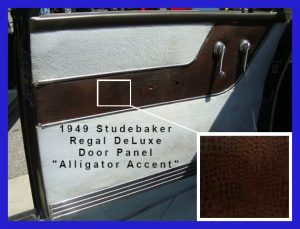 Interior changes, new fabrics are seen and two-tone upholstery combinations are increased. For Regal DeLuxe accents, “Alligator” vinyl would be used on door panels, arm rests and piping. The dash facing behind the three instruments is now engine-tuned, that treatment would also be seen on all the Hawk dashes from 1956 to 1961.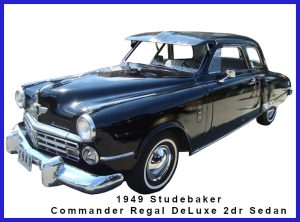
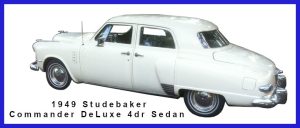 Model lineup is nearly the same as 1948, 2-door sedan, 4-door sedan, Starlight coupe (formerly 5-passenger coupe), in DeLuxe and Regal DeLuxe trim. In Regal DeLuxe trim only, two additional models are available, a convertible and the Land Cruiser sedan. Right above photo, is a 4dr Sedan DeLuxe, note the lack of sill trim and the rubber gravel guard. Left above photo, is a very rare (1 of 934) 2dr Sedan in Regal DeLuxe trim, note stainless steel sill trim and gravel guard.