
1942 Commander 12A
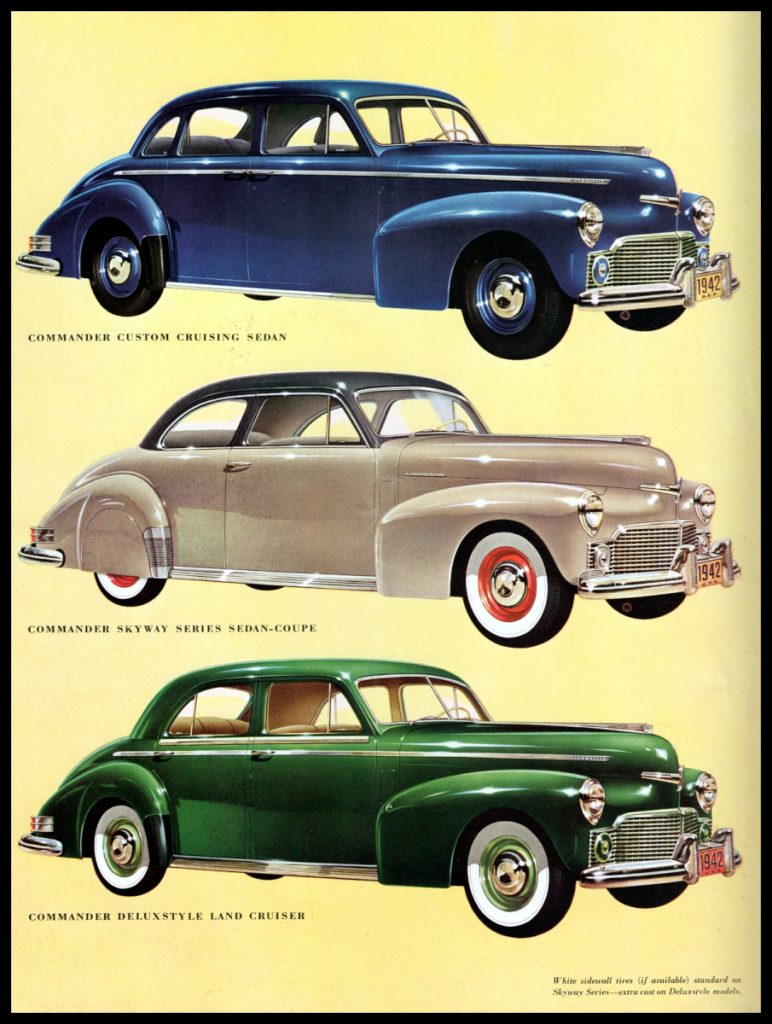
As in 1941, there were three trim levels, Custom, Deluxestyle (replacing Delux-tone), and Skyway. Each series had a Cruising Sedan, a Sedan Coupe, and a Land Cruiser.
The major trim differences are; Skyways have two-toned paint, rear fender skirts, stainless moldings around the windows, and chrome rear-fender gravel shields. They also sport a “Skyway Commander” badge on the rear lower side of the hood, but do not have the full length belt line molding found on the Deluxestyle and Custom lines.
Deluxstyle cars have wide stainless moldings below the side windows and black rubber gravel shields.
Custom have no window bright trim and rubber gravel shields. Both Custom and Deluxestyle belt moldings have “Commander” stamped in the front.
1942 Commanders have a new stainless grille that covered the entire front of the car, with horizontal bars emphasized and the vertical bars as background. The grill had two round blank spots, below and slightly inboard from the headlights, used for optional fog lights. Massive new bumpers and bumper guards with built in license plate holder front and back.
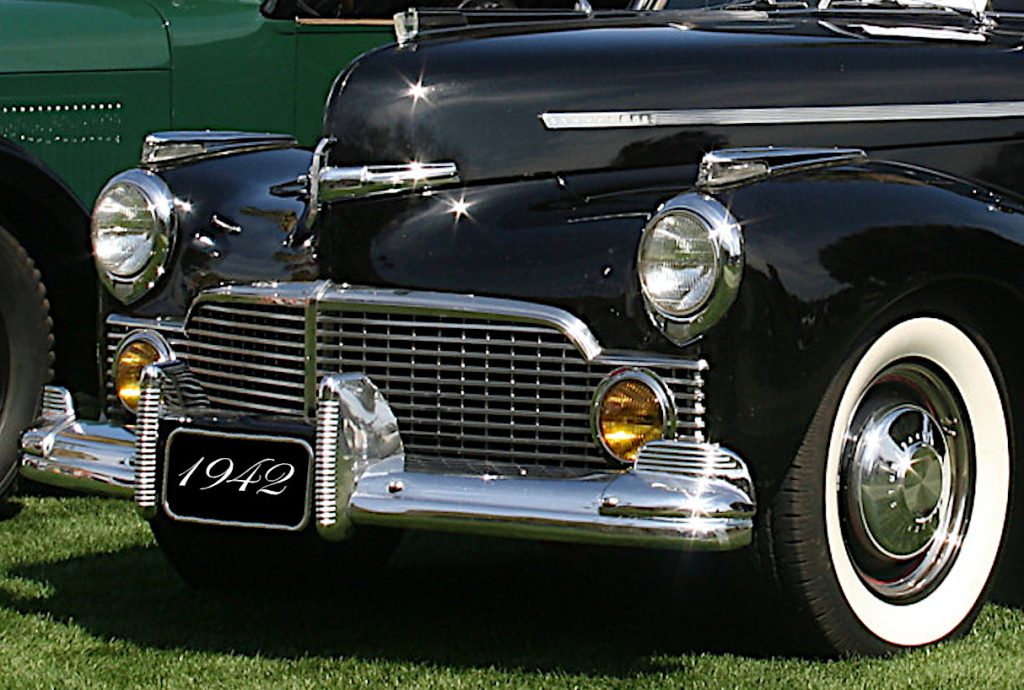
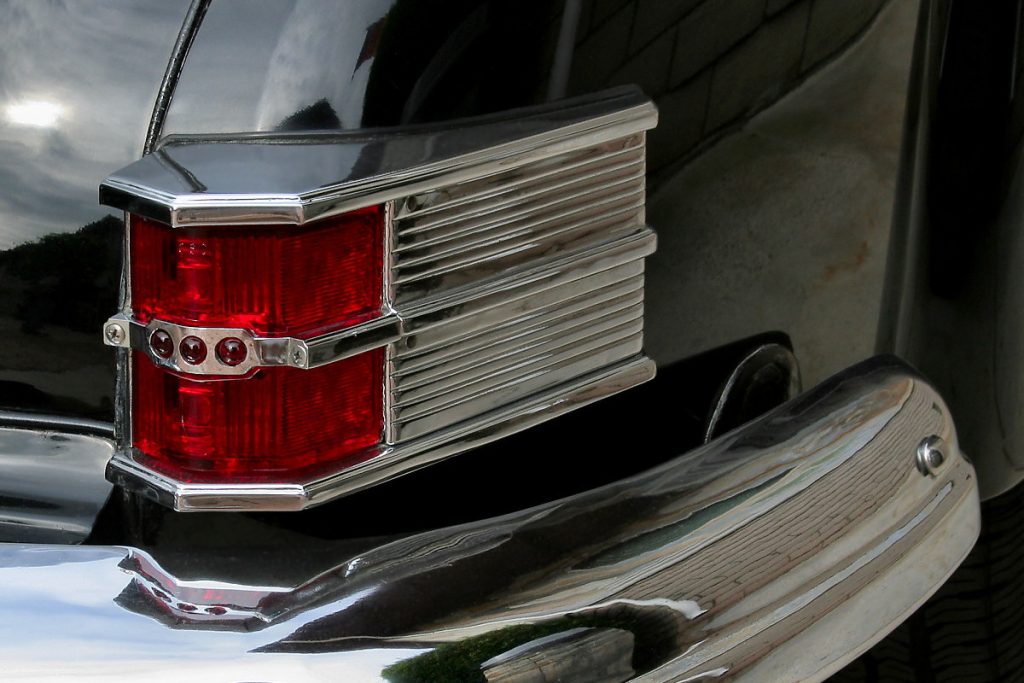
Large new horizontal tail lights, wrapping around the rear fenders, inside large chrome housings, with dual lamps, one for flashing indicators and the other for tail light/brake light. New hood ornaments, trunk and hood badges, and trunk handle were in place. Parking lights were found on top of the front fenders in long chromed housings’. The only bright work, not new for 1942, was the headlight rings.
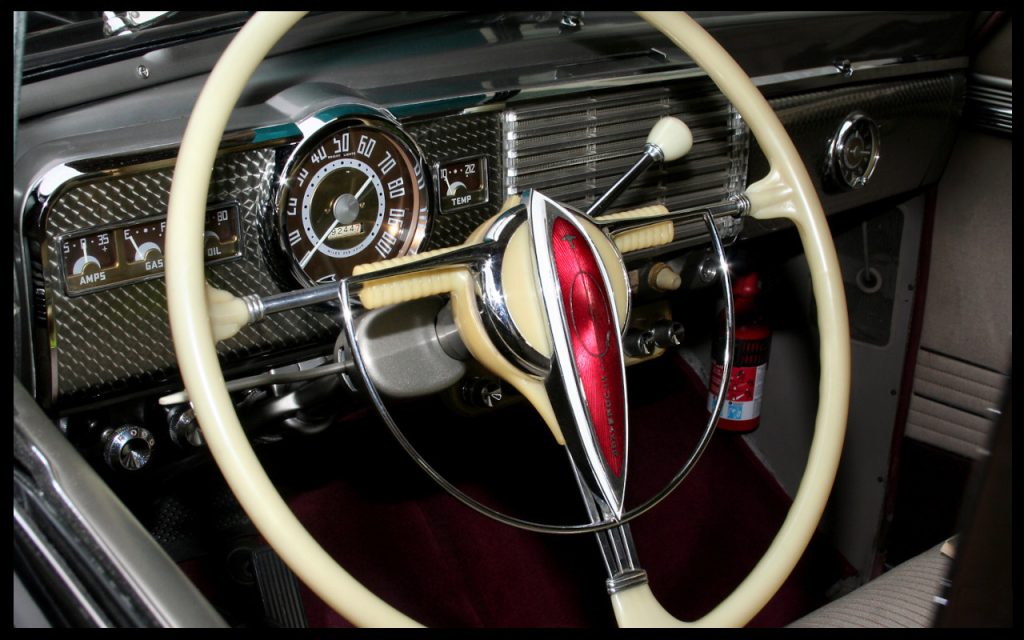
Instrument panels were redesigned and very attractive. The finish of the radio grille was clear lucite. Seat bottoms were wider; upholstery and door panels more luxurious. Dual sun visors, windshield wipers, and horns were standard on all models. Deluxestyle models had a front seat back garnish trim panel with ashtray and two courtesy lights, as well as three chrome moldings on the inside door panels, and two-tone exterior and interior colors and trim. Skyway models had bolster type pleated upholstery and Lucite door hardware panels.
Accessories:
- Directional signals $19.25
- Radio and steering-wheel radio remote control $70.25
- Rear-seat radio remote control (foot-activated button mounted on the floor) $5.25
Just a few of the accessories offered in 1942.
Mechanical:
Few changes were made, however Commanders were equipped with Autolite ignition, and the starter button moved from the dash, too under the clutch pedal, like the 1941 Champions.
Side Bar:
1942 Turbo-matic Drive. This innovation consisted of a fluid coupling, an automatic vacuum-operated clutch, and a conventional three-speed transmission with kickdown overdrive. The clutch pedal was eliminated, and gear shifting was reduced to a minimum. Only six cars were actually equipped with a Turbo-matic, three were Presidents and three Commanders. It is not known whether any were ever released to the public. By the time World War II was over, real fully automatic transmission technology was available and this transmission design never used.
Black Out Cars:
All Studebaker cars built on or after January 16, 1942, were considerably altered in appearance. This was the result of the government attempt to conserve certain critical metals like chromium, nickel, and stainless steel by requiring most brightwork to be eliminated on all American cars. Studebaker referred to these cars as “series 90”. In order to provide vehicles that would approximate their glittery predecessors, Studebaker used noncritical metals like Indium silver, and utilized baked-enamel finishes in colors that would offer pleasing contrast to that of the body. Production of the series 90 Commanders, during the last two weeks of January 1942 was 1,688. Surviving examples are quite rare.
| When data was available from Turning Wheels (TW) or Studebaker the Complete Story (STCS) it is used. Else, The Classic Car Database (TCCD) & The Standard Catalog of American Cars (SCAC) is used. →Information found between the arrows is from Turning Wheel feature articles written by Fred Fox← What we can be fairly sure of is that the same body styles, depending on the source, were sometimes listed in different terms. SB= South Bend, LA= Los Angles, and CAN= Canada |
| 1942 Model 12A Commander | |||
Model | Doors | Passenger | Price |
| Custom four-door Cruising Sedan (W3) | 4 | 6 | $1,045.00 |
| Deluxestyle four-door Cruising Sedan (W5) | 4 | 6 | $1,090.00 |
| Skyway four-door Cruising Sedan (W7) | 4 | 6 | $1,125.00 |
| Custom Land Cruiser (B1) | 4 | 6 | $1,080.00 |
| Deluxestyle Land Cruiser (B3) | 4 | 6 | $1,125.00 |
| Skyway Land Cruiser (B7) | 4 | 6 | $1,160.00 |
| Custom Sedan-Coupe (F3) | 2 | 6 | $1,025.00 |
| Deluxestyle Sedan-Coupe (F5) | 2 | 6 | $1,070.00 |
| Skyway Sedan-Coupe (F7) | 2 | 6 | $1,105.00 |
| As we were unable to find a TW article for 1942 Commanders, the data show above was taken from SCAC which indicated that production started in August of 1941 and ended in January of 1942. They fixed production at 17,500 units. According to STCS the starting serial numbers for 1942 Commanders is 4,216,501 for SD and 4,816,601 for LA. No ending serial numbers are listed, so production cannot be calculated from the serial numbers. However, if you look at the starting serial numbers for 1947 Commanders for SB and LA, 4,232,501 & 4,818, 501 respectively, it would appear that 17,900 1942 serial numbers were assigned, slightly more then the 17,500 production number reported by SCAC. The starting Engine Number is H-164,301, the ending number is not listed. However, 1947 Commander Engine Numbers start at H-182,001 so most likely 17,700 Engine Numbers were assigned to 1942 Commanders. Interestingly TCCD, while listing the exact same model line-up, also listed each models price at exactly $83.00 more, leading us to wonder if a price increase was initiated. | |||