
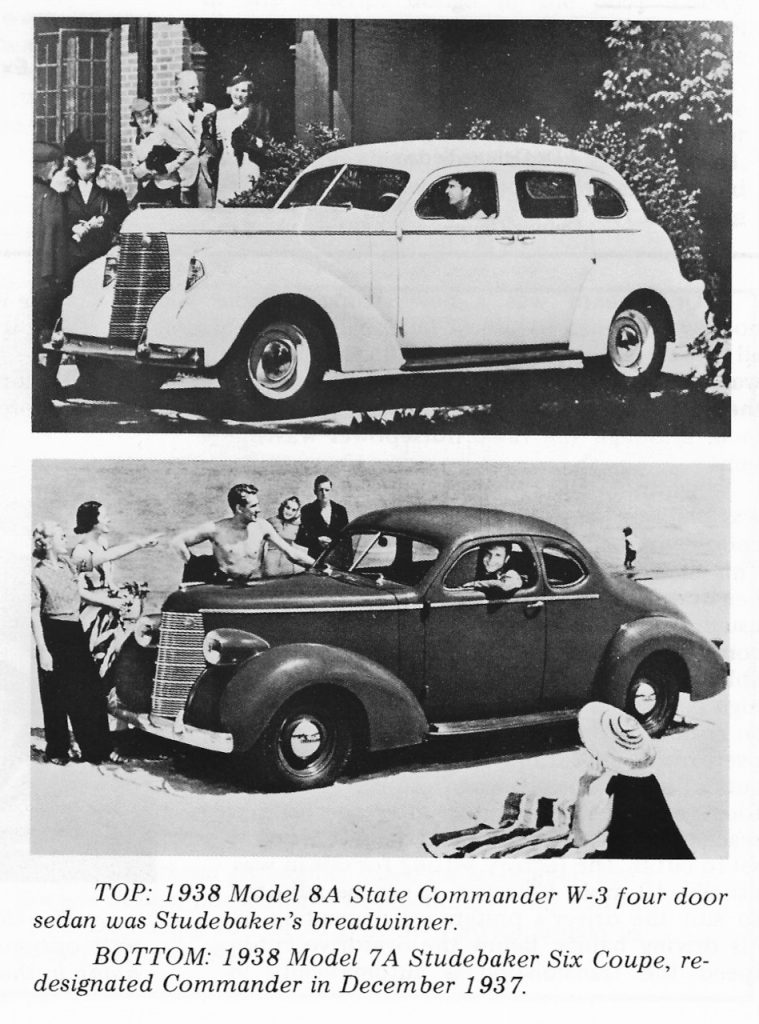
There were no actual changes to either of the series. So, what is the difference between a Commander and a State Commander? There are few, but the most noticeable is that Commanders have bullet style headlights, mounted on the catwalks and State Commanders have the President style (Cathedral) faired in headlights, which makes each series easy to identify. Other equipment standard on State Commanders and optional on Commanders was deluxe steering wheel, twin horns, and Hill-Holder. State Commanders also have better appointments in the interior.
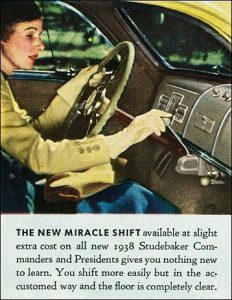 “Miracle Shift.” The control for this unit was mounted in the center of the lower part of the dash, which left the floor clear for easier seating of three front seat passengers. It operated on the standard “H” shift pattern. It was often troublesome and when “three on the tree” came out in 1939, became obsolete.
Tell’s for 1938:
- The new design for this year is much smoother, much lower, and six inches wider
- The hood louvers are eliminated and the cars are nearly void of trim
- A simple chrome bead molding stretches from the grille to the rear deck
- Series 7A have bullet-shaped headlights mounted on the catwalks
- Series 8A have Cathedral headlights
- A new instrument panel has square gauge clusters
- The grille seems taller and narrower
- The grille has five distinct sections, separated by wider horizontal bands
- The grille vertical center bar from last year is gone
Mechanical:
The engine, used on both series, formally used on the Dictator, is bored out 1/16th of an inch to 226.2 cubic inches, but makes the same 90 HP. The the engine and seats are moved forward, the distance varies from 3 ½ to 5 ½ depending on which source you believe. The front seat is at least five inches wider, Studebaker claimed six. The tunnel is nearly eliminated by turning the transmission on it’s side. The wheel base is 116 ½ inches, ½ inch longer then the 1937 Dictator it replaced. Planer suspension, safety glass, dual tail lights, dual wipers and divided windshields are standard equipment. Also included at regular price was a speedometer, engine thermometer, Autolite ignition, Borg clock, Casco cigar lighter, two-way Houdaille shock absorbers, spring covers and Bud steel disc wheels.Optional Equipment:
Most of the options are not mentioned. However, two items which seemed to get a lot of play are the free-wheeling overdrive transmission and the the vacuum actuated Evans“Miracle Shift.” The control for this unit was mounted in the center of the lower part of the dash, which left the floor clear for easier seating of three front seat passengers. It operated on the standard “H” shift pattern. It was often troublesome and when “three on the tree” came out in 1939, became obsolete.