1934 Commander B
We were unable to find any TW articles for the 1934 Commander B series. Fox and Cannon did not elaborate much in “Studebaker the Complete Story”, so this section has to rely on other less reliable sources once again.
The entire line of Studebaker cars are redesigned for 1934, however the actual difference is more subtle then one might think. The general body lines and contours are altered, becoming more aerodynamic. Thus the sales pitch for 1934 “From the Skyway Comes Their Style”.
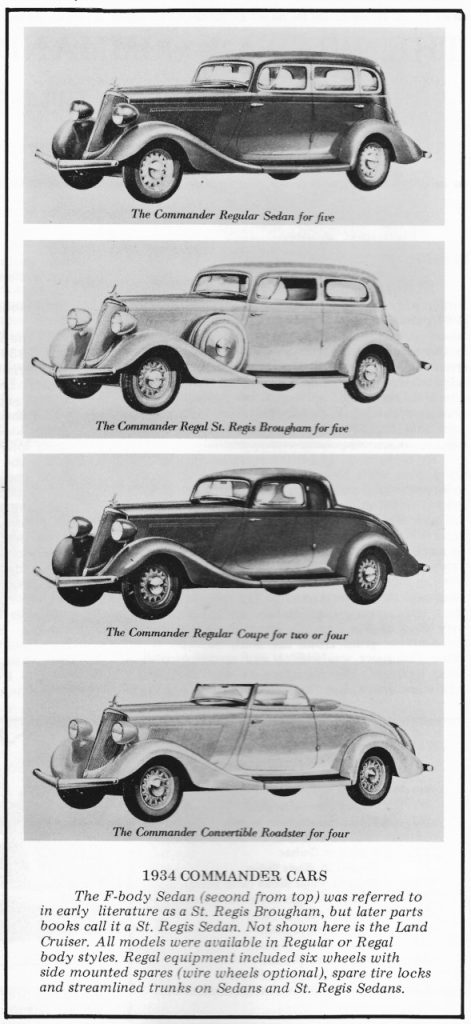
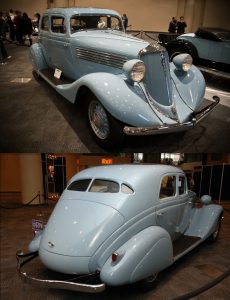
The old box design is gone forever. The headlights are now round bullet-shaped pods, mounted on the fenders near where the parking lights had been since 1931. The bumpers are now two straight single bar units, mounted in a V pattern, the V-shaped dip in the center is gone. The belt line which had been so prominent in past years is nearly invisible, simply embossed into the body lines, dropping sharply down near the rear of the cars. From all the photo’s we looked at, it appears that the front doors are now hinged at the back and open from the front, while the rear doors are hinged in the front and open from the back. The hood louvers are even more slanted, with an embossed line around them. The grille is deeper and more slanted. The front fender aprons and the grille panel are significantly extended out the front of the cars. New tail lights are built into the rear fenders. Wind wings on the front of closed cars roll up and down. The third window on sedans opens, pivoting in the middle. The interiors are exceptional, with very fine appointments. The fabric is broadcloth or mohair, the dash panel and steering wheel are new. The Convertible Sedan’s were eliminated this year.
However, there is some evidence that Studebaker did a “Year Ahead” style change in June of 1934 for Regal’s and Custom, where the major influenced was a move from vertical to horizontal hood louvers. Also, at about this same time the new and sensational Land Cruiser in DeLuxe and Regal trim is introduced.
Tell’s for 1934:
- Thehood louvers are more slanted and have an embossed line around them
- Headlights round bullet-shaped
- Straight single bar bumper
- Belt line nearly invisible
- Front door (Suicide)
- Tail lights are integral to the rear fenders
- Mascot, still the art deco bird, standard on all models
Mechanical:
The model B Commander chassis is new, running on a 119 inch wheelbase. The engine for the Model B Commander is the same as the earlier Dictator eight with 221 cubic inch displacement. However a higher compression ratio of 6.3 to 1 and an aluminum cylinder head, boosted the horsepower to 103. Vacuum powered Bendix brakes were continued. An innovation was the triple beam headlamps. A control on the instrument panel allowed the driver to select one of three high beams.
Side Bar:
On March 18, 1933 Studebaker was forced into receivership. Vance and Hoffman of Studebaker and Bean of White Motors are appointed receivers. By the extraordinary efforts of Vance and Hoffman, Studebaker was out of receivership on March 9th, 1935. This action is to complicated to cover here. It is mentioned here, because through Vance and Hoffman’s effort, the Federal Court approved an expenditure of $700,000 to retool a completely new line cars for 1934.
| When data was available from Turning Wheels (TW) or Studebaker the Complete Story (STCS) it is used. Else, The Classic Car Database (TCCD) & The Standard Catalog of American Cars (SCAC) is used. →Information found between the arrows is from Turning Wheel feature articles written by Fred Fox← What we can be fairly sure of is that the same body styles, depending on the source, were sometimes listed in different terms. SB= South Bend, LA= Los Angles, and CAN= Canada |
| 1934 Model B Commander | |||
| Model | Doors | Passenger | Price |
| St. Regis Brougham (C1) | 2 | 5 | $915.00 |
| Regal St. Regis Brougham (C2) | 2 | 5 | $965.00 |
| Regular two-passenger coupe (Q1) | 2 | 2 | $895.00 |
| Regal two-passenger coupe (Q2) | 2 | 2 | $925.00 |
| Regular four-pass coupe w/rumble seat (Q3) | 2 | 4 | $945.00 |
| Regal four-pass coupe w/rumble seat (Q4) | 2 | 4 | $975.00 |
| Regular Roadster w/rumble seat (R1) | 2 | 4 | $945.00 |
| Regal Roadster w/rumble seat (R2) | 2 | 4 | $975.00 |
| Regular 4dr Sedan (W1) | 4 | 5 | $945.00 |
| Regal 4dr Sedan (W2) | 4 | 5 | $995.00 |
| DeLuxe Land Cruiser (L3) * | 4 | 5 | $1,135.00 * |
| Regal Land Cruiser (L2) * | 4 | 5 | $1,135.00 * |
| Production starts in September of 1933 and ends in October of 1934 (SACA). According to STCS, the starting SB serial number was 8,045,001 – up. CAN serial numbers started at 8,951,001 to 8,951,200 (200). Engine Numbers started at C-20,001 – up. The next series of Commander serial numbers, assigned to 1935 Commander 1B starts at 8,103,000. So we clearly do not know the ending serial number for 1934 SB production. TCCD and SCAC both put production at 10,315 units and both list the same models, except for the DeLuxe Land Cruiser, which only Fox listed (See next section). → * In the TW Article “Studebaker’s 1934 – 1954 Land Cruiser Models” by Fred Fox, it is stated that both the DeLuxe and Regal (L3 & L2) were produced in the spring or summer of 1934. However, only one price was given. Production of the 1934 Land Cruiser was 203 units. The difference between DeLuxe and Regal Land Cruiser was DeLuxe had a single spare in the trunk and Regal had dual side mounts.← |
|||
