
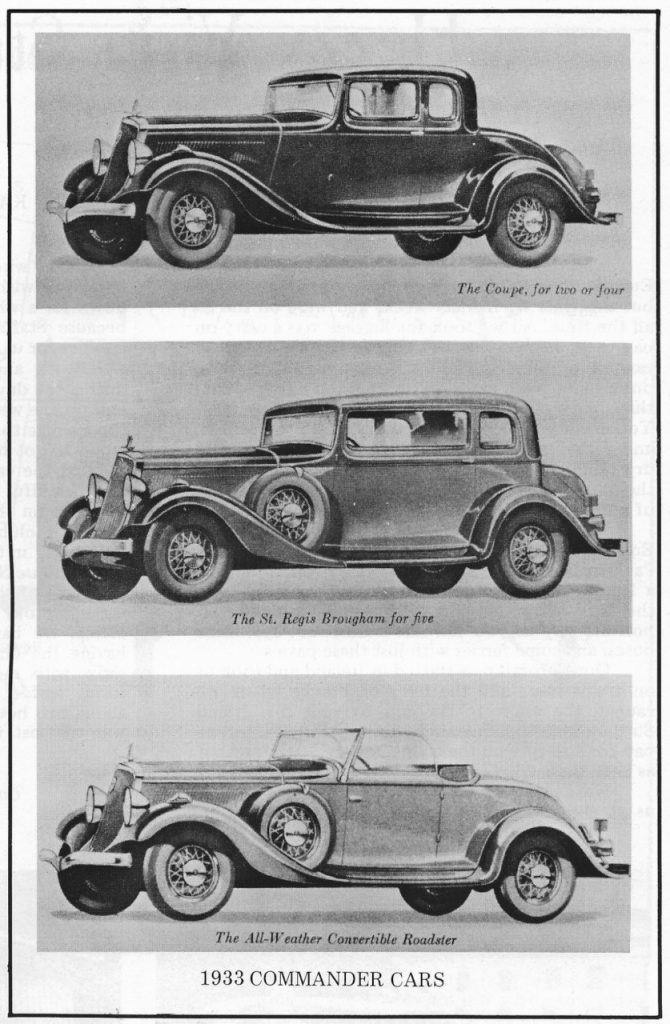
So, what happened to the “72” commander? Well as is seems, Studebaker was quite concerned about the 1932 sales results, and according to Fox, very close the start of 1933 production a major re-alignment of Studebaker’s 1933 models line-up was made. The 56 Six remained the same, however, the model 63 Dictator replaced the model 72 Commander and was designated the model 73 Commander. The model 72 Commander became the model 82 President, and the model 92 President became the model 92 Speedway President. This move allowed Studebaker to offer Commander 8’s at Dictator prices and the smaller President 8’s at Commander prices. This apparently is a ploy that had been used often in the automotive industry.
The entire Studebaker line shared the same styling, slightly modified from 1932, with a more radically forward sloping grille. The front fenders aprons extend further forward and have skirts that hide more of the frame and running gear. Roof lines blend smoothly into concave rear decks. Five painted wire wheels are standard, chromed wire wheels are optional at extra cost. Regal’s ran standard on plated artillery wheels with 14 spokes. These wheels were were available as extra cost options on regular models. Another popular option was white wall tires. Upholstery material was Bedford Cord (standard) on all closed models and optional on four-door convertible sedans. Mohair was an extra cost option on all closed models. Leather was standard on Roadsters and optional on four-door convertible sedans.
Tell’s for 1933:
- The hood louvers are now slanted, in line with the slanted grille
- Painted wire wheels (Standard, Chrome optional)
- Fourteen spoke artillery wheels (Standard on Regals, optional on Regular models –1932’s had ten spokes)
- Optional chrome artillery wheels
- More slanted grille and windshield
- Front fenders skirted for the first time covering more of the chassis and (if equipped) side mount cavities
- No wood spoke wheels (maybe they could be special ordered?)
- Mascot, still the art deco bird, now standard on all models
Mechanical:
The model 73 Commander had a slightly larger (one year only) 236 cubic inch displacement straight eight, making 100 HP and ran on a 8 inch shorter 117 inch wheel base, formally used on the 1932 Dictator’s. The wheels changed from 18 inches to 17 inches. Down draft carburetors were used in all Studebaker engines for the first time. Other new innovations were automatic choke, automatic spark advance, and automatic manifold heat. New Bendix vacuum-boosted power brakes were also standard equipment on all Studebaker’s. The Startix automatic starting system was continued from it’s 1932 introduction.
However, all these new features and fanatic styling did little to improve sales. Studebaker was forced into receivership on March 18th, 1932. But as we all know, would rise from this low point and survive until 1966. Exterior color offering changed almost monthly according to Fred Fox. The cars were painted in five different areas, lower body, upper body, fenders, wheels, and stripes using all kinds of color combinations.
When data was available from Turning Wheels (TW) or Studebaker the Complete Story (STCS) it is used. Else, The Classic Car Database (TCCD) & The Standard Catalog of American Cars (SCAC) is used.
→Information found between the arrows is from Turning Wheel feature articles written by Fred Fox←
What we can be fairly sure of is that the same body styles, depending on the source, were sometimes listed in different terms. SB= South Bend, LA= Los Angles, and CAN= Canada
| 1933 Model 73 Commander | |||
|---|---|---|---|
| Model | Doors | Passengers | Price |
| Regular 4dr Sedan (W1) | 4 | 5 | $1,075.00 |
| Regal 4dr Sedan (W2) | 4 | 5 | $1,180.00 |
| Regular St. Regis Brougham (C1) | 2 | 5 | $1,075.00 |
| Regal St. Regis Brougham (C2) | 2 | 5 | $1,180.00 |
| Regular two-passenger coupe (Q1) | 2 | 2 | $1,000.00 |
| Regal two-passenger coupe (Q2) | 2 | 2 | $1,105.00 |
| Regular four-pass coupe w/rumble seat (Q3) | 2 | 4 | $1,050.00 |
| Regal four-pass coupe w/rumble seat (Q4) | 2 | 4 | $1,155.00 |
| Regular 4dr Convertible Sedan (S1) | 4 | 5 | $1,195.00 |
| Regal 4dr Convertible Sedan (S2) | 4 | 5 | $1,300.00 |
| Regular Roadster w/rumble seat (R1) | 2 | 4 | $1,095.00 |
| Regal Roadster w/rumble seat (R2) | 2 | 4 | $1,200.00 |
| Front and rear bumpers, although standard, were an extra $25.00. They are not included in the above prices. They were later called a delete option. | |||
| Fox did not mention the production start or end dates for the Model 73 Commanders. However, SCAC indicated production started in November of 1932 and ended in July of 1933. →Studebaker assigned 3,781 SB serial numbers and 60 CAN serial numbers to the Model 73. Fox reported SB production at 3,781 and CAN production at 60, most likely calculated from the serial numbers assigned. Engine Serial Numbers are reported at 8,040,001 to 8,043,781 for SB and 8,950,801 to 8,950,860 for CAN. For more complete information see TW Dec. 1991← SCAC and TCCD both reported total 73 Commander production at 3,841 as did Fox. |
|||