
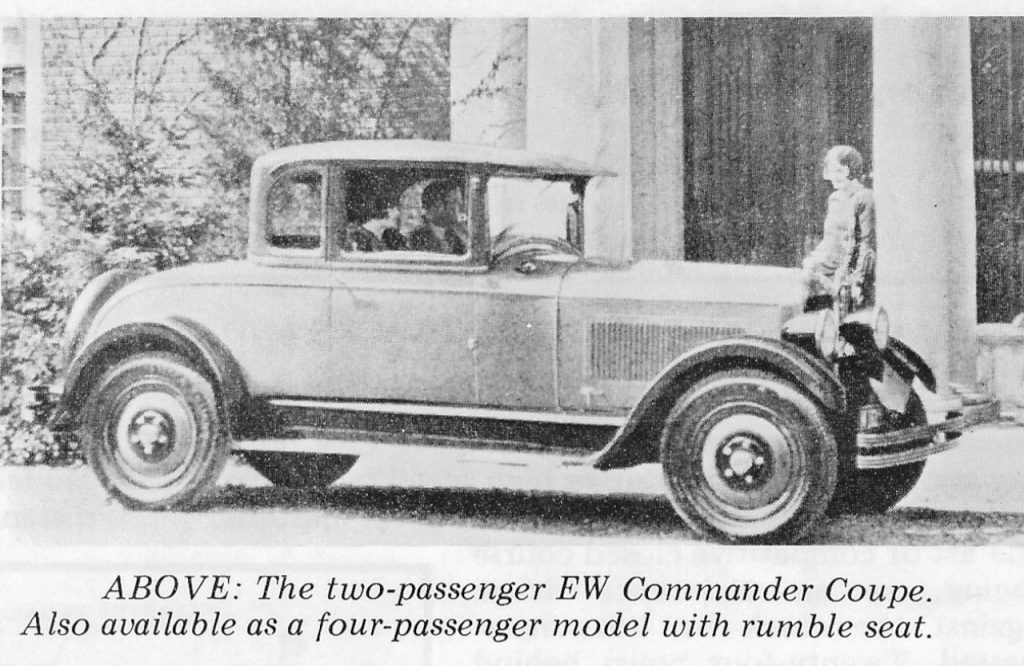
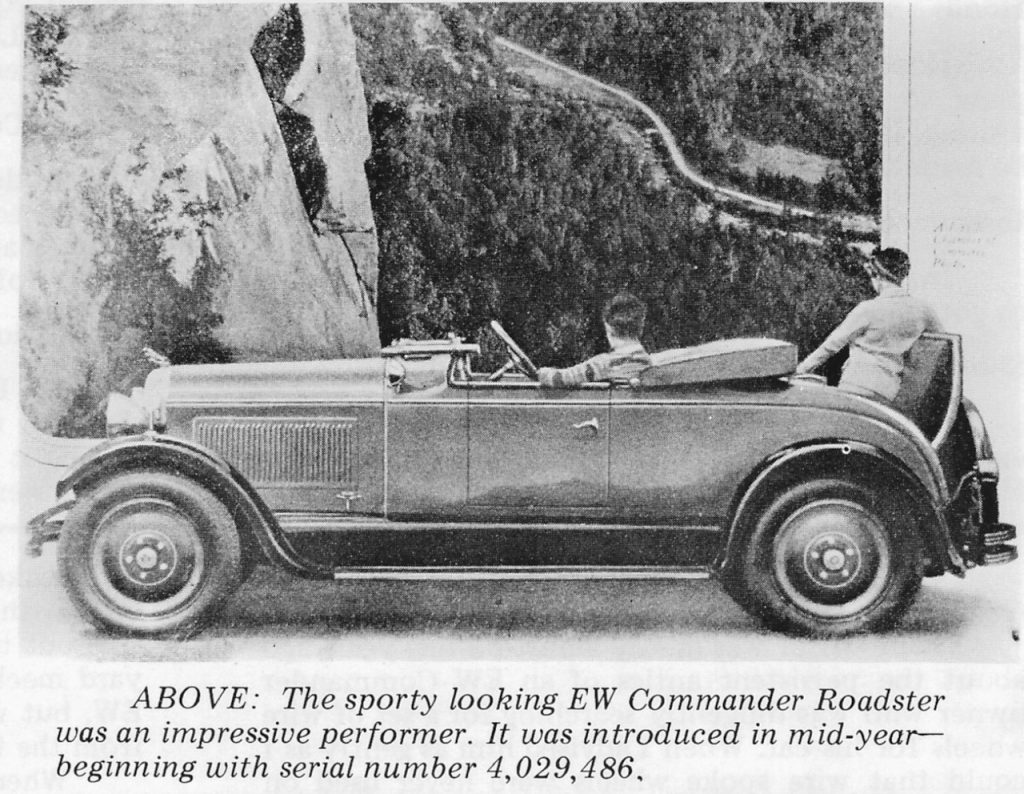
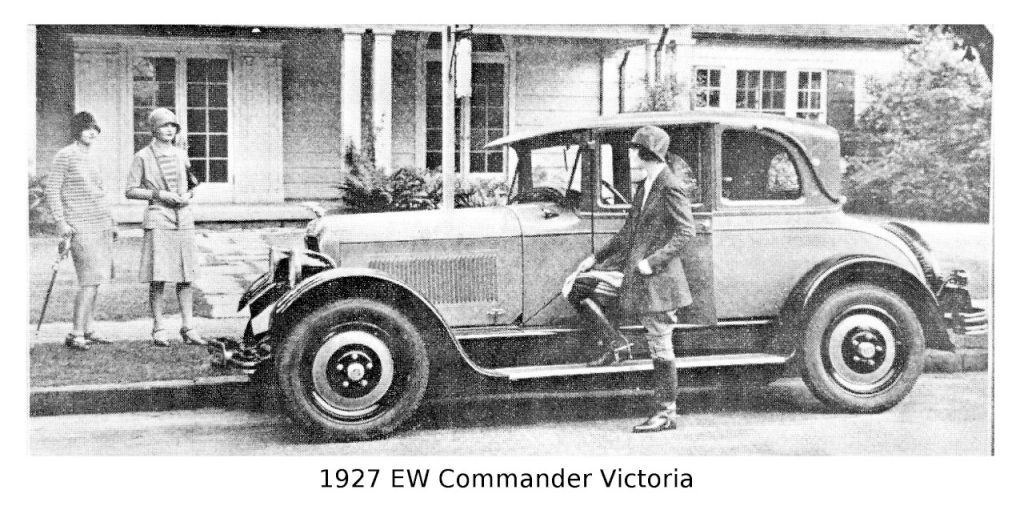
Most of the information next, is from an article written by Bill Cannon “The Antique Studebaker Review” Vol 17 NO. 3
The EW Big Six was released in January of 1927. It would replace the 120 inch wheelbase ES Big Six which had been in production since mid-1926. According to William Cannon , the Studebaker service bulletins for January, February, and March 1927, still referred to the EW as a Big Six. There was no April service bulletin, but the May service bulletin references the Commander name for the first time. However, the April 1927 “Studebaker Wheel” describes the “Commander” as the latest member of the famous Big Six family. But to further complicate the issue, an ad copy issued February 16th, 1927, Studebaker announces several prices cuts, it included the “Commander Big Six Brougham”. So, the exact time, the name changed to Commander, is unknown but did happen early in 1927, with the EW Model.
The EW is so much like the ES model, the differences are nearly indistinguishable, except for the fact all EW’s used disc wheels with five stud nuts. Neither wood wheels or wire wheels will fit, because of Studebaker’s change to four wheel brakes, this problem would be fixed in 1928 with a redesign of the front axle. The list below outlines the improvements that came with the Model EW.
- Weight reduction results in better performance.
- Lighter front axle with plain bearings replacing the roller bearing in the knuckles.
- Redesigned steering gear.
- Wheels are changed from 22 inches to 21 inches.
- Oil capacity reduced to 6 ½ quarts.
- Semi-automatic spark control w/lever on the instrument panel.
- Stromberg carburetor replaces Ball & Ball carburetor.
- Manifold heat control on instrument panel, rather then on the intake manifold.
- Transmission and rear axle lighter, but of equal strength.
- Smaller brakes, equally effective because of the weight reduction.
Price reduction was also a large factor in the success of the EW series. Where a ES Brougham had been priced at $1,985, the EW started at $1,785, was reduced to $1,585 in February, and further reduced to $1,485 in September.
EW Body types were: (“The Antique Studebaker Review” Vol 17 NO. 3 by Bill Connon”)
- (Brougham) Sedan
- (Custom) Coupe
- (Custom) Coupe w/rumble seat
- Victoria
- (Chancellor) Victoria – (likely later in the year, the Regal Victoria)
- Sport Roadster
- Regal Sedan*
- Regal Victoria*
Later in the year*
EW running changes were many, but the major visible changes are when the radiator shell changed from nickel to chrome and from the rounded design to the flatter design. Headlights were initially black and nickel bullet-shaped, except all nickel on the Chancellor, until the radiator shell change. After the radiator change, the headlights were black with chrome on regular cars and all chrome on Regal trim cars. A second type “Acorn Style” headlights may have been used on some late production cars.
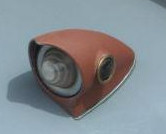 All EW’s used the torpedo type cowl lights except the later Regal cars, which mostly likely changed with the introduction of chrome, to an Acorn type, as seen in the photo to the right.
The instrument panel also changed from an oval design to the gothic design at the same time as the change from nickel to chrome.
End of information derived from the article written by Bill Cannon in “The Antique Studebaker Review” Vol 17 NO. 3
Tell’s for 1927 EW:
- Double-bar fluted bumpers
- Atalanta radiator mascot
- five stud disc wheels.
Side Bar:
- Studebaker at this time used the term “Brougham” interchangeable with “Sedan”. In the carriage and early horseless carriage days a “Brougham” contained a separate closed cabin for the passengers, while the driver remained outside. But later it [Brougham] defined a model where the driver and passengers were in the same cabin, but usually denoting a higher level of luxury.
- The Chancellor name however, did indicate a more luxurious interior with a vanity case and deluxe hardware.
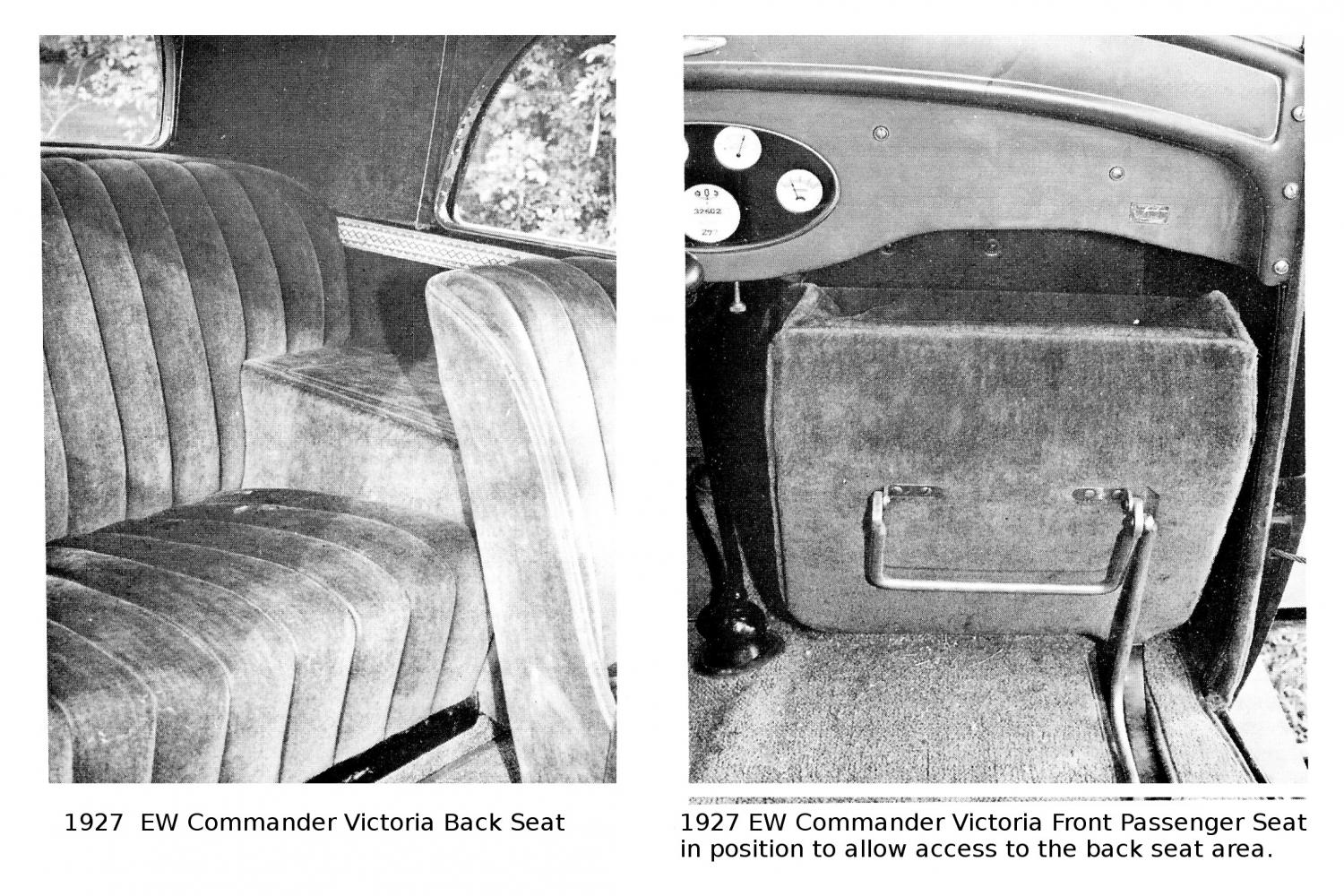 The Victoria, while using two doors and looking much like a coupe, has a back seat. Entrance is gained to the back seat, by folding the front passenger seat forward. The rear window is much larger then the Coupes and it has a Landau bar above that window. The Victoria had much richer appointments. The EW Victoria for some unknown reason used a different bumper (Biflex) then all the rest of the EW’s which used the Eaton double-bar fluted bumpers.
- During 1927 a multitude of performance and endurance records were set with the use of Studebaker Commander’s. This topic is to extensive to cover here.
- Most of the information above was gleaned from an article written by Bill Cannon in “The Antique Studebaker Review” Vol 17 NO. 3 Names contained within the () came from Cannon and differ from the TW’s articles written by Fox, and the model names in the charts below.