
1939 Commander 9A
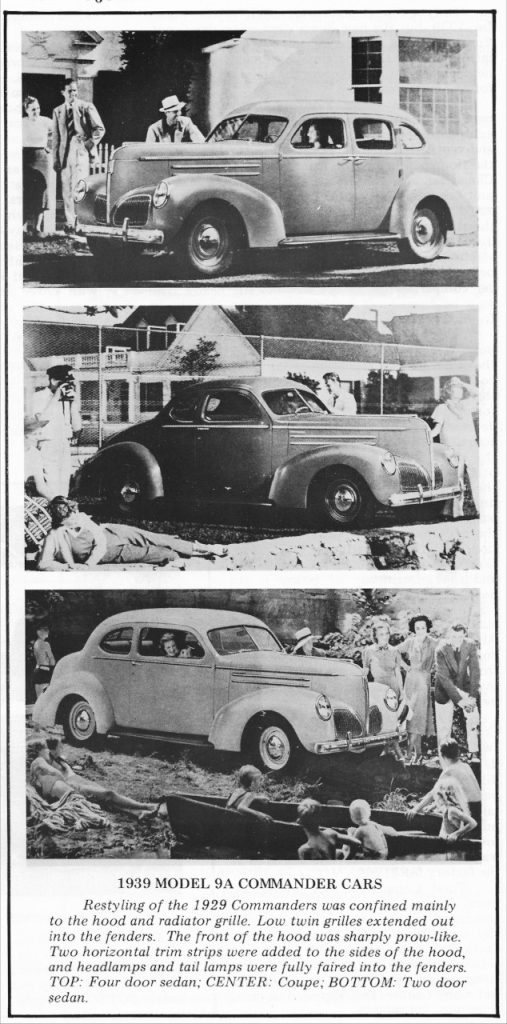
With 1938 being a new design, the 1939 Commander is simply a face lift from the cowl forward, but the change to the grille is different then anything we have seen before. The tall vertical grille from the past is gone. It is replaced by two separate grilles on either side of the now bare nose, inserted into the front fenders just inside the new headlights which are completely faired into the fenders. The grille section are roughly one half as high and twice as wide, covering two thirds of the front of the car. This shorter wider grille pattern would remain with Studebaker until the end. We also see new tail lights built into the rear fenders. The new headlights are slightly oval and not as yet seal beams, although after 1940 there would be a kit available to change the 39 headlights to sealed beams. Another distinction of 1939 Commander’s is the two chrome trim strips on the side panels, below the hood and just below the belt line trim that extends from near the front of the hood to near the back of the car. Note, that the 1940 Commander would have only one strip, while the 1938 had none.
The interior has a new instrument panel and the panel and window moldings are painted in a wood burl pattern. The interior hardware was finished in plastic, harmonizing with the interior color. This was an extension of the Lucite speedometer and clock facings used in 1938 Commander’s.
Tell’s for 1939:
- New taillights built into the rear-fender
- New oval headlights faired into the front fenders
- New lower, wider grille
- Two chrome strips under the hood
Mechanical:
The first for Studebaker, steering column three-speed gear shift lever, seen on some GM cars in 1938, it is adopted by nearly all American manufactures this year. Die-hards, at least early in the year could order cars with floor shift. The overdrive transmission is modified with a switch under the accelerator petal. When pushed all the way to the floor, is allowed you to move out of overdrive without slowing down. When the switch is made, a solenoid shuts off the engine for 1/5 of a second, relieving the torque on the transmission, which allowed the overdrive pawl to disengage the sun gear. This is a big advancement over earlier systems. Also, the overdrive cut-in speed is reduced from 40 to 30 mph. All Studebaker overdrive systems would remain this way until the end of production. Note: overdrives were first introduced in 1935 Presidents. 1939 would also see the introduction of the famous Studebaker Climatizer heating and ventilating system. To began with the unit was under the drivers side seat, later it would move the under the passenger side seat. While the name would continue to the end of production, the last year it was placed under the passenger side seat would be 1959 for sedans and 1963 for Hawks. The wheel base remains at 116 ½ inches.
| When data was available from Turning Wheels (TW) or Studebaker the Complete Story (STCS) it is used. Else, The Classic Car Database (TCCD) & The Standard Catalog of American Cars (SCAC) is used. →Information found between the arrows is from Turning Wheel feature articles written by Fred Fox← What we can be fairly sure of is that the same body styles, depending on the source, were sometimes listed in different terms. SB= South Bend, LA= Los Angles, and CAN= Canada |
| 1939 Model 9A Commander | |||
| Model | Doors | Passenger | Price |
| Four-door Cruising Sedan w/ trunk spare (W3) | 4 | 5 | $965.00 |
| Two-door Club Sedan w/ trunk spare (F3) | 2 | 6 | $955.00 |
| Four-door Convertible Sedan w/ trunk spare (S3) | 4 | 6 | $1,290.00 |
| Three Passenger Custom Coupe w/ interior spare (Q1) | 2 | 3 | $900.00 |
| Three Passenger Business Coupe w/ interior spare (Q1) | 2 | 3 | $875.00 |
| Four-door Station Wagon * | 4 | ? | ? |
Studebaker parts books listed a (W7), (F7), and (Q7) Deluxe Models. What constitutes “Deluxe” is not well defined. 1939 price lists show a “Deluxe Equipment Package” at an additional $30.00. This package included a Phantom Steering Wheel, Horn Ring, Electric Clock, Cigar Lighter, and extra Horn.
|
|||
| Fox indicated that production started in August of 1938 and ended August of 1939 for Commanders. SCAC indicated production started in September of 1938 and ended in August of 1939. →Studebaker assigned 38,500 SB serial numbers and 5,300 LA serial numbers to the Model 9A. Fox reported two sources for 1939 production, the first reports 43,724 for SB and LA combined, the second lists SB at 38,493 and LA at 5,260, 29 more units. The second sources may have included bare chassis sales. Engine Serial Numbers are reported at H-42,501 to H-87,600. For more complete information see TW Oct. 1990← * SCAC listed a Station Wagon (No Price), TCCD did not list the Convertible Sedan or the Station Wagon. They both reported total Commander production at 43,724 as did Fox in source one. |
|||