1932 Series 72 Commander
Again, we do not have access to a TW articles for the 1932 Commander 71 series. Fox and Cannon, in “Studebaker the Complete Story” was fairly thin. So like 1931, this is what little information we could scare up.
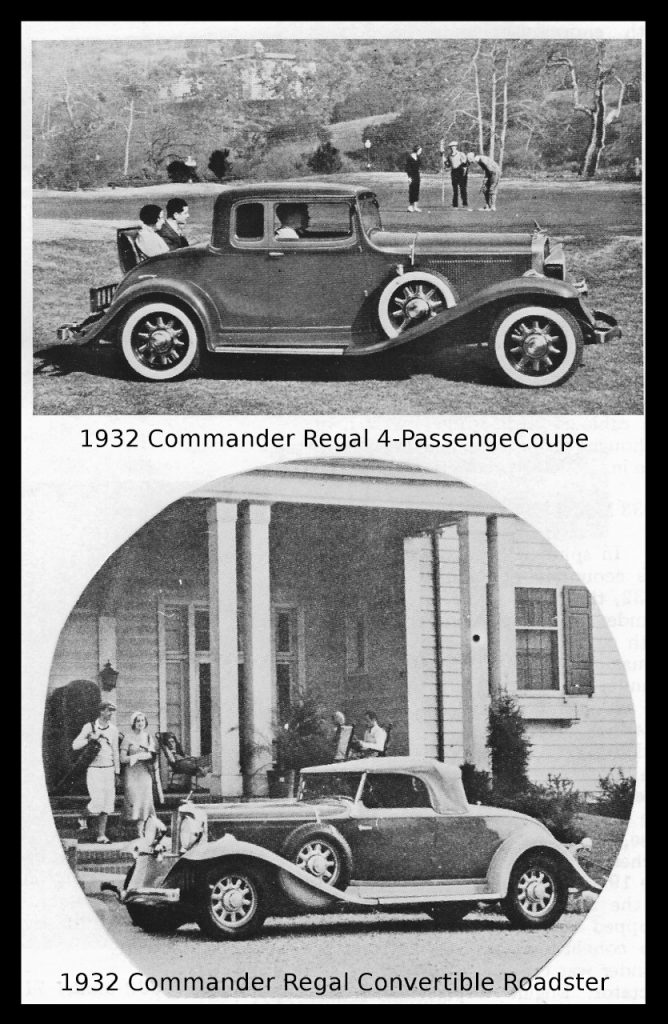
1932 Commander line-up was expanded. Open cars again appeared; Convertible Sedan, Regal Convertible Sedan, Roadster, and Regal Roadster were added. A new St. Regis Brougham and Regal St. Regis Brougham were also added, as well as a Regal Coupe. The Regal Brougham and Victoria are gone (see side bar 2 below). Last years Sedan, Regal Sedan, and Coupe are still in the line-up. Regal equipment includes six, side mounted, wire or chrome platted artillery spoke wheels; duel trumpet horns; and a luggage rack. The package could be applied to any standard model at extra cost. Wire or steel spoke artillery wheels are also available options. The instrument panel is redesigned with airplane-type round dials.
Tell’s for 1932:
It is difficult to tell the 1932 Studebaker from the 1931, however on closed cars, the polo cap is gone and all the windshields began to slope forward. The gages on the dash inside are round instead of square. Parking lights are still placed on top of the front fenders. Regal’s have the new art deco “Bird” mascot radiator cap, optional on all other models.
Mechanical:
A new synchromesh transmission is introduced and freewheeling is removed from the transmission, placed in a separate unit and bolted on the back of the transmission. Houdaille automatic-ride shock absorbers replace the Delco-Lovejoy units and Startix automatic starting systems is a new standard item. A newer style cable-controlled Bendix braking system is used. The wheelbase increases to 125 inches.
Side Bar:
The Startix system was an automatic engine starting mechanism. It automatically started an engine from cold or restarted the engine if stalled. All you had to do to activate it, was turn on the key. It was supplied to vehicle manufacturers in the 1930s by Bendix Corporation.
The St. Regis Brougham (left) , unlike the former Studebaker Brougham, is a two door close-coupled sedan. For Studebaker, it was said to combine the luxury features of the former Victoria’s with the roominess of a sedan. Thus, the Victoria’s and Brougham’s become expendable. This car has an extremely wide doors (supposedly the longest door Studebaker ever made) which assisted rear passenger access to the back seat.
| When data was available from Turning Wheels (TW) or Studebaker the Complete Story (STCS) it is used. Else, The Classic Car Database (TCCD) & The Standard Catalog of American Cars (SCAC) is used. →Information found between the arrows is from Turning Wheel feature articles written by Fred Fox← What we can be fairly sure of is that the same body styles, depending on the source, were sometimes listed in different terms. SB= South Bend, LA= Los Angles, and CAN= Canada |
| 1932 Model 71 Commander | Model | Doors | Passenger | Price |
| Convertible Roadster (R1) | 2 | 2-4 | $1,350.00 |
| Regal Convertible Roadster (R2) | 2 | 2-4 | $1,455.00 |
| Convertible Sedan (S1) | 4 | 5 | $1,465.00 |
| Regal Convertible Sedan (S2) | 4 | 5 | $1,570.00 |
| Coupe (Q1) | 2 | 2-4 | $1,350.00 |
| Regal Coupe (Q4) | 2 | 4 | $1,455.00 |
| Sedan (W1) | 4 | 5 | $1,350.00 |
| Regal Sedan(W2) | 4 | 5 | $1,455.00 |
| St. Regis Brougham (C1) | 2 | 5 | $1,350.00 |
| Regal St Regis Brougham (C2) | 2 | 5 | $1,455.00 |
| Production began in November of 1931 and continue to November of 1932 (SCAC). According to STCS, the starting SB serial number was 8,036,001 and ended at 8,040,000 (4,000). CAN serial numbers started at 8,950,700 and ended at 8,950,800 (100). TCCD and SCAC both put production at 3,551 units, slightly under the total number of serial numbers assigned (4,100). Engine Numbers started at C-12,001 and ended at C16,100 (4,100). While SCAC and TCCD did agree on the 1932 Model line-up, SCAC priced all the models $95.00 more each except the Coupe’s, where they were in agreement. The data shown is from TCCD, | |||
