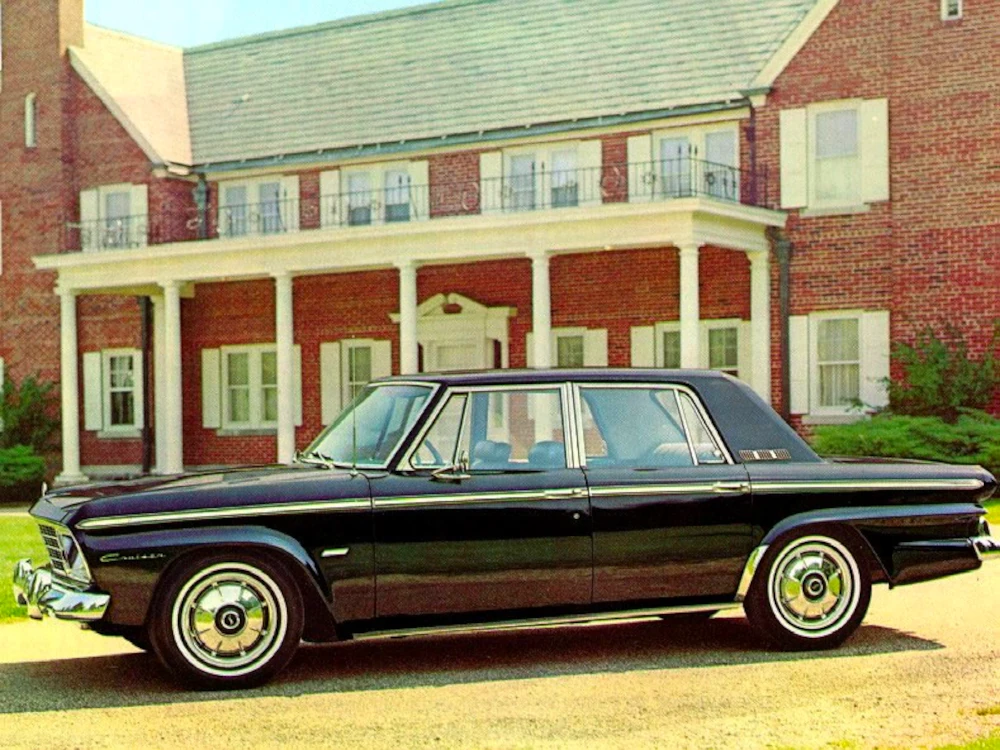
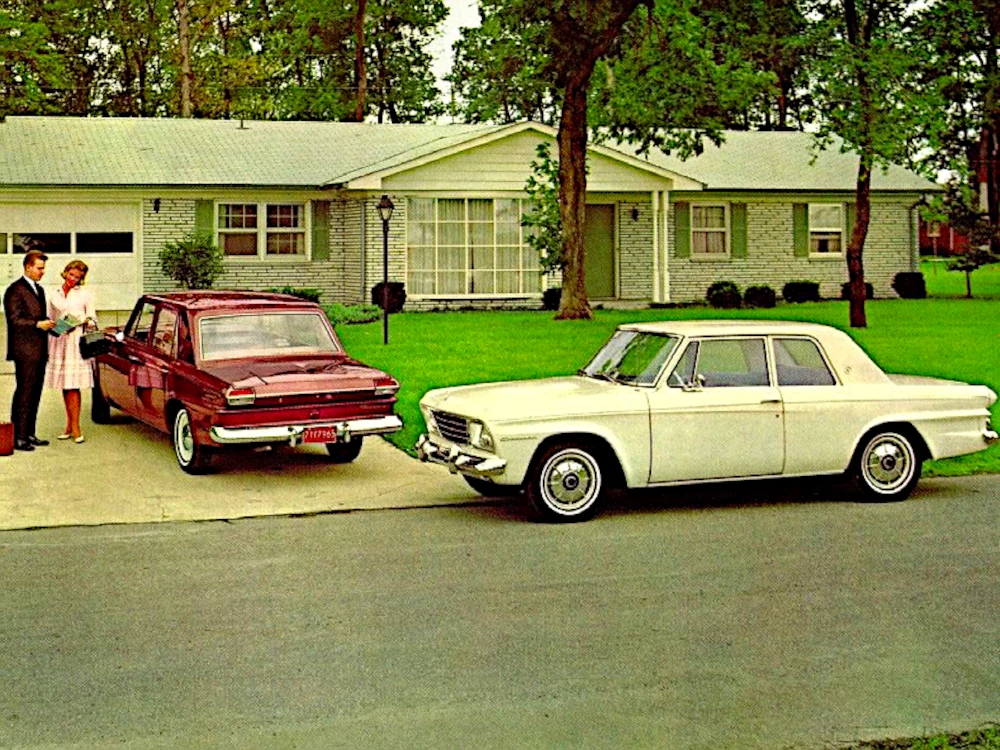
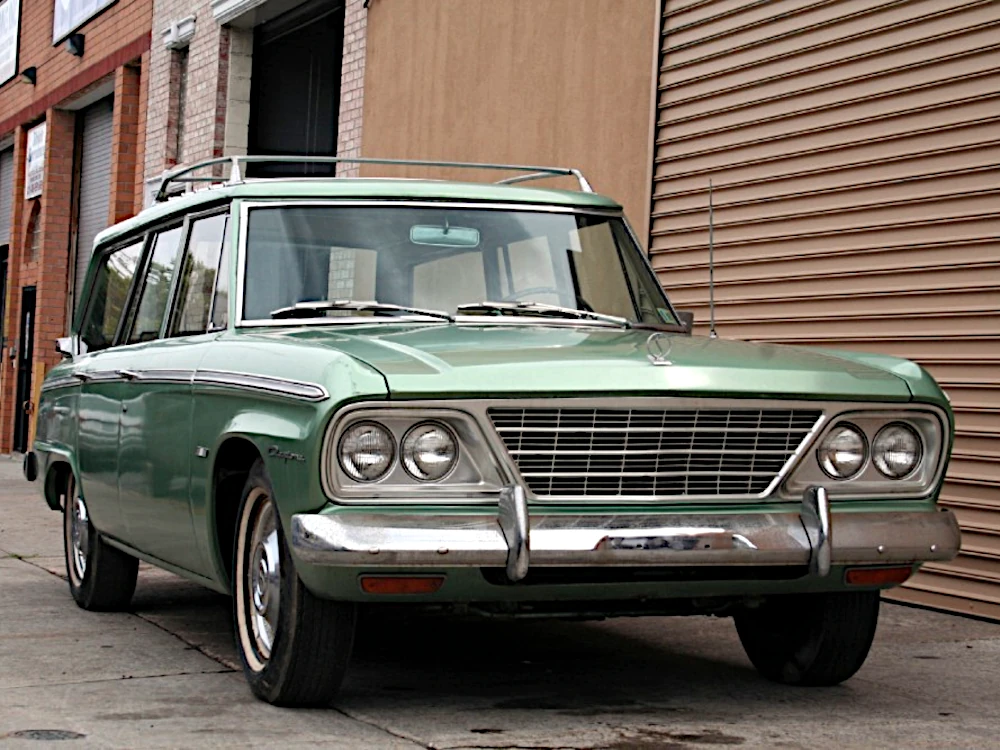
*** 1965 *** Studebaker Cars

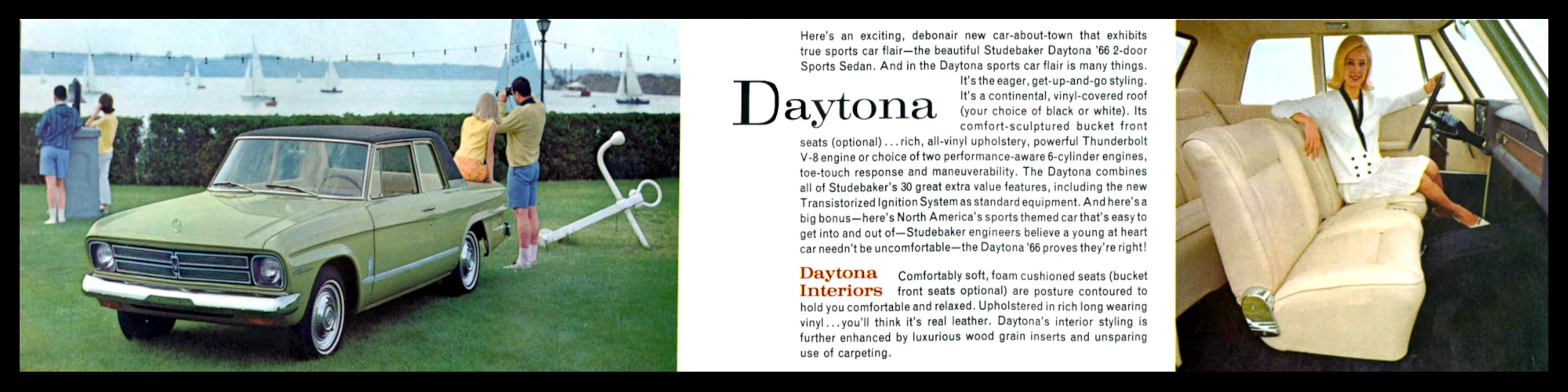
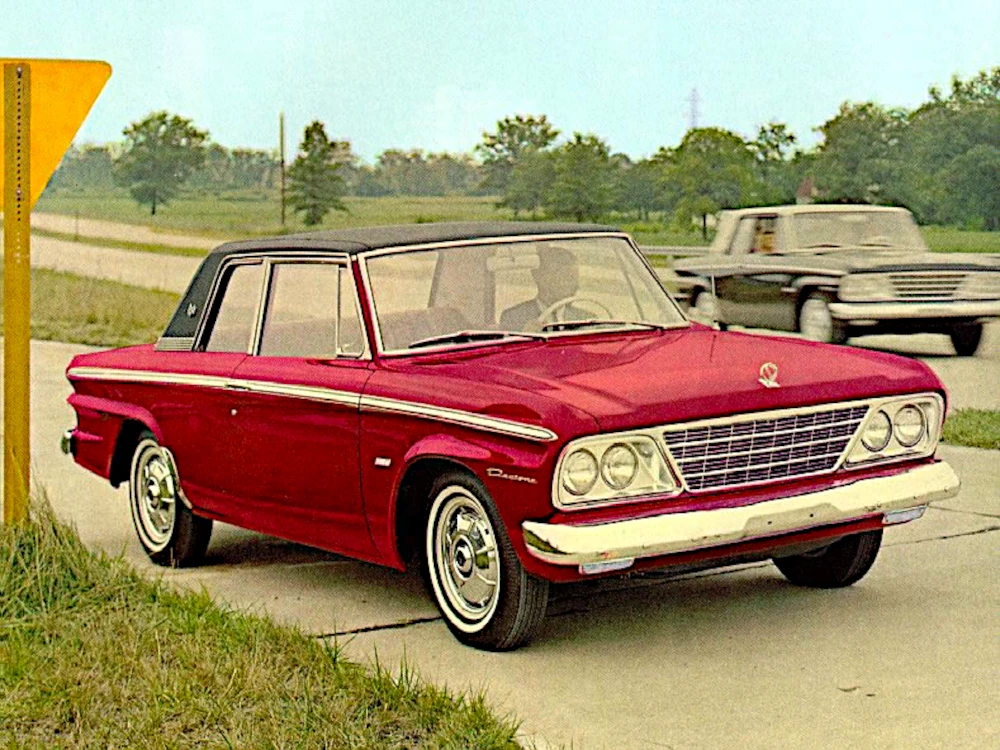
Daytona Sports Sedan
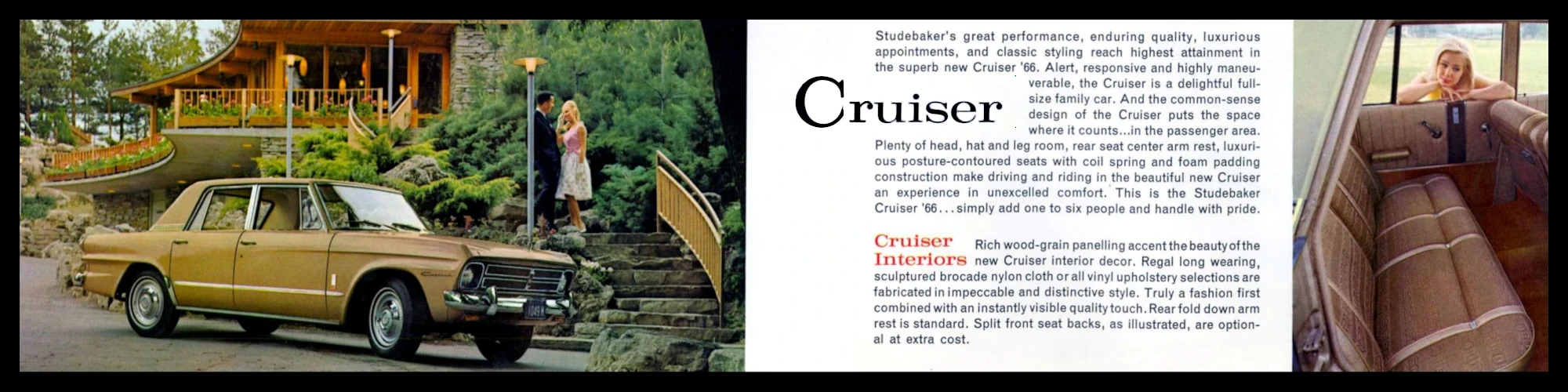
Cruiser 4dr Sedan
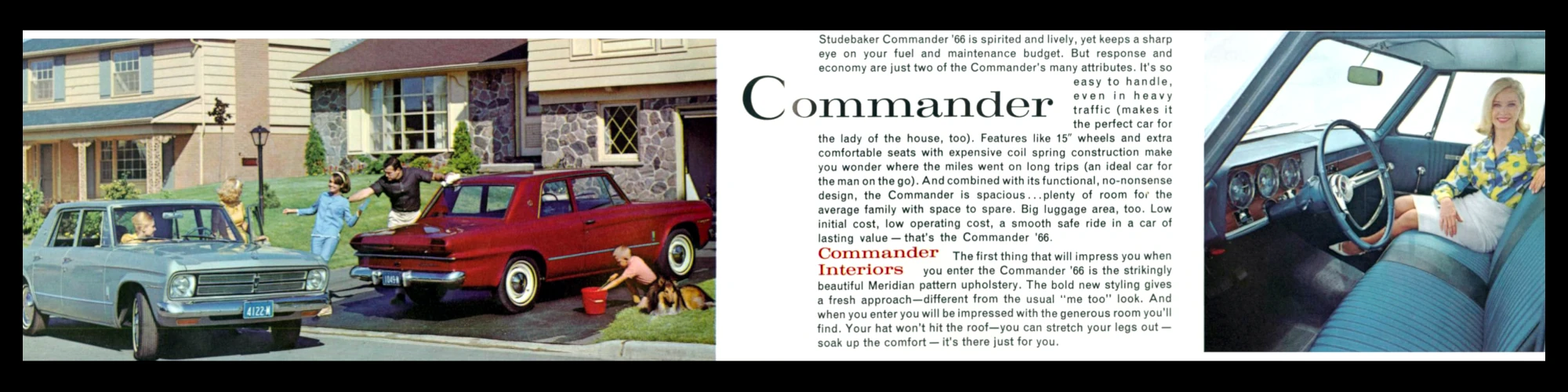
Commander 4dr Sedan & 2dr Sedan
Commander Wagonaire

In order to understand the 1965 Studebaker cars we need to take a brief look at the 1964 model year.  As we all know on December 20th, 1963 South Bend production ended.

While the main Studebaker automobile assembly line in South Bend shut down, engine assembly and foundry operations continued for several months, lasting until roughly May 1964.  Some truck production also continued shortly after the initial shutdown, but major manufacturing operations ceased, with production moving to Hamilton, Ontario.


With the end of operations at the South Bend plant foundry and engine assembly operation, Hamilton needs to find another source for engines.  One might ask “why not just continue foundry and engine assembly in South Bend?”  According to the Fred Fox TW article September 2012, “In mid-1964, Studebaker was producing less than 2,000 cars a month.  The engine plant facilities at South Bend had the capacity to build 20,000 engines a month.  To operate it at less then 10% capacity was not economically feasible.”


So………………, here comes the McKinnon (ChevyBaker) engines.  The transition to a new engine series was extreamly difficult considering the change had to be made using the same bodies and frames used in the 1964 car production.  Harm Arnold and his small Hamilton engineering team would have their work cut out.  New motor mounts need to be designed, clearance problems overcome, the new engines needed to be matched with existing Borg Warner transmissions.  All with a production start date of September 21, 1964.  The job gets done, but not without having to sacrifice some optional equipment offering.  Initially no air conditioning, no six cylinder power brakes, and no Hill Holder.  Most of the options and accessories were phased in during the model year.

So much of the engineering effort was put into the engine swap that there would be little time or money left for any styling changes.  Thus, except for some minor items, the 1965’s looked just like the 1964.  This would be were the Studebaker’s advertisements took over, claiming the lack of styling change resulted in the…

 “The 1965 Studebaker [is] the Common-Sense car because the body style doesn’t change every year.”


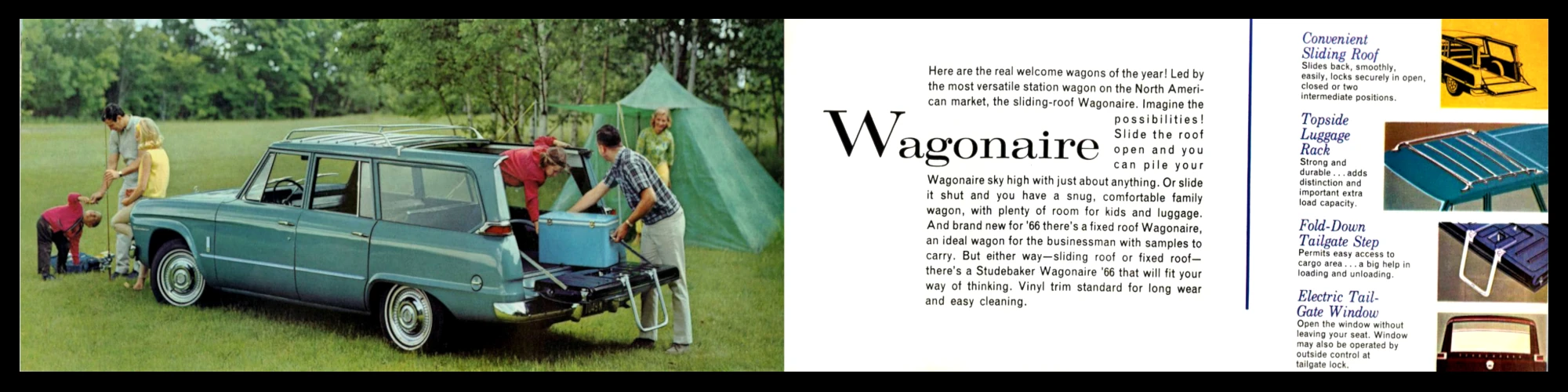
For 1965 the Daytona convertibles and hardtops were discontinued and a new Daytona V8 Sports Sedan was added.  It was an F-bodied 2dr coupe and had a standard vinyl covered roof and a dressed up interior.  All six-cylinder Daytona’s were discontinued and a six-cylinder Cruiser was added.  The fixed roof Wagonaire option was eliminated and only the standard sliding roof unit was available.

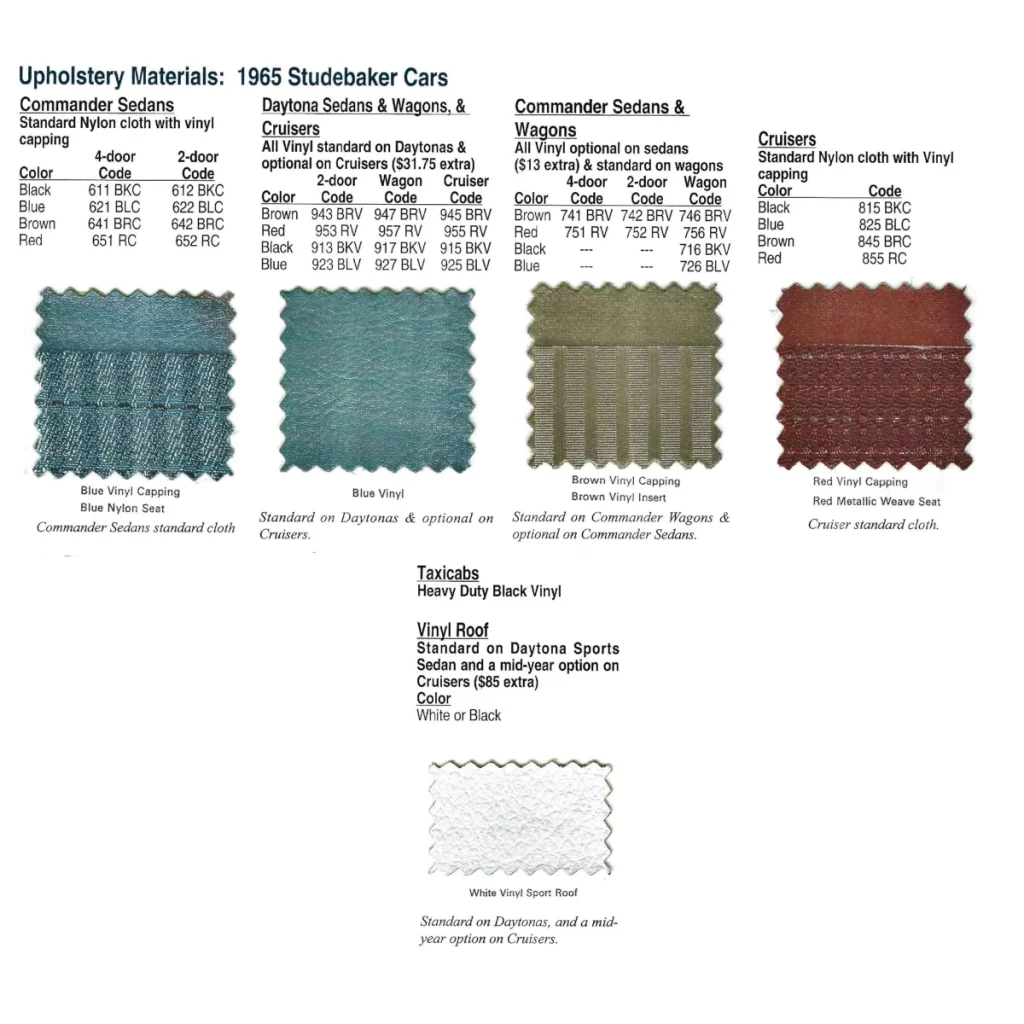
Both the Daytona Sport and the Cruiser have a new horizonal trim strip added to the crease just above the gas filler cap.  The horizonal deck lid wide trim is replaced with a slim trim strip which had been used on 1964 Challengers and Commanders.  This trim is also used on the 1965 Commanders.  The amber parking lights, introduced in late 1964 models are carried forward on 1965’s.  Duel headlights are now standard on all 1965 Studebaker cars.  On the interior a new parking light warning light is added to the dash.  Cigarette lighter and manual windshield washer are now standard equipment.  The Cruiser broadcloth upholstery option is deleted, other wise interior fabrics and colors are similar to 1964.  A rear fold-down arm rest similar to those seen on Hawk’s is added to the Daytona Sport Sedan.  Individual reclining front seats are optional on Cruisers.

Tells:

One quick way to identify 1965 Studebaker cars, (unmodified) is the single tailpipe exists the rear of the car on the drivers side.  Studebaker engined single exhaust was on the passenger side.  There was no duel exhaust option offered for 1965.  Of coarse you could also look under the hood.

1965 Running Changes


Although all 1965 Studebaker’s look about the same, several running changes were actually made during the model year. Continuing a policy established by Sherwood Egbert with the Avanti, running changes were made whenever it was felt advantageous to do so. The following is a list of some of the most significant running changes.

  1. In late November 1964, an oil bath air cleaner was made a factory installed option for six-cylinder models.
  2. In January 1965, the Transistorized Ignition System was introduced as standard equipment on the Daytona Sports Sedan and was an option on all other models. This system had first been offered as standard equipment on R3 Avantis and an option on R1 and R2 1964 Avantis.
  3. In late January 1965, a Taxicab package was introduced for six-cylinder Commander four-door sedans.
  4. In mid-year, a new air conditioner with rectangular vents in the evaporator was introduced. Although the 1963-64 round vent style was shown in the accessory brochure and owner’s guide, evidence seems to indicate that round vent style units were not factory installed in 1965 Studebaker’s.
  5. During mid-year, the accelerator pedal was changed to the “suspended” style.
  6. In mid-year, the off white instrument panel rocker switches were changed from the former grooved style to a smooth faced style.
  7. During mid-year, the steering wheels were changed from all white (actually white painted on black wheels) to various colors that matched the interiors.
  8. During mid-year, the valve covers were changed from yellow to black.
  9. During mid-year, the rear axle shafts were changed from the tapered end style to the flanged end style. These had first been used on R3 Avantis.
  10. During mid-year, a new “Super-safe” door latch assembly was introduced. It was actually similar to an older style used by Studebaker.
  11. In April 1965, a vinyl roof covering was made an option on Cruisers.
  12. Two types of windshield washer containers were used; one a plastic bottle and the other a plastic bag.
  13. Three different styles of door sill plates were used in 1965: one with squares with crosses and X’s through the squares, one shiny and smooth, and one with lines of out-of-round circles.

Detailed Production: 1965 Studebaker Cars

The following 1965 production figures came from Studebaker form #C285 (Framing and Production Reports-Hamilton) supplied years ago to Art Unger by Jack Holden, Hamilton’s 1963-66 Supervisor of Scheduling.
Six Model Code Std. OD Auto Floor 3-Spd(1) RHC Std. RHC Auto CKD(2) Total Assembled Export(3)
Commander 2dr Sedan S-F4 1,711 126 1,231 0 0 0 0 3,068(5) 12
Commander 4dr Sedan S-Y4 1,392 497 1,853 49 0 0 528 4,319 56
Commander Wagonaire S-P4 284 94 186 0 0 0 0 564 11
Daytona 2dr Sport Sedan(4) S-F8 0 0 1 0 0 0 0 1 0
Daytona Wagonaire(4) S-P8 1 0 0 0 0 0 0 1 0
Cruiser 4dr Sedan S-Y9 128 74 589 0 0 0 0 791 15
Total   3,516 791 3,860 49 0 0 528 8,744 95
                     
V8 Model Code Std. OD Auto Floor 3-Spd(1) RHC Std. RHC Auto CKD(2) Total Assembled Export(3)
Commander 2dr Sedan S-F4 135 81 306 0 0 0 48 5,70(6) 1
Commander 4dr Sedan S-Y4 415 364 1,976 0 2 3 1,584 4,344 62
Commander Wagonaire S-P4 98 80 359 0 0 2 0 539 8
Daytona 2dr Sport Sedan S-F8 115 141 1,370 0 0 0 0 1,626 12
Daytona Wagonaire S-P8 53 81 588 0 0 1 0 723 4
Cruiser 4dr Sedan S-Y9 60 187 2,647 0 4 3 0 2,901 24
Total   876 934 7,246 0 6 9 1,632 10,703 111
                     
Grand Total   4,392 1,725 11,106 49 6 9 2,160 19,447 206


Models, Prices & Weights: 1965 Studebaker Cars

Six “S” Model C-114
ModelCodePrice ($)Shipping Weight (lbs)
Commander 2dr SedanS-F4$2,1252,695
Commander 4dr SedanS-Y4$2,2302,815
Commander WagonaireS-P4$2,6203,246
Cruiser 4dr SedanS-Y9$2,4702,815
Taxi Sedan 4drS-Y4T$2,365?
V8 “V” Model C-51
ModelCodePrice ($)Shipping Weight (lbs)
Commander 2dr SedanV-F4$2,2652,891
Commander 4dr SedanV-Y4$2,3702,991
Commander WagonaireV-P4$2,7603,461
Daytona 2dr Sport SedanV-F8$2,5653,006
Daytona WagonaireV-P8$2,8903,501
Cruiser 4dr SedanV-Y9$2,6103,066
Notes:
1) Prices given are in U.S. Dollars and include Federal Excise Tax. On June 22, 1965, because of a 3% reduction in the Federal Excise Tax on the dealer net price, the price of all models was slightly reduced.
2) The 1965 V8 is referred to ais the Model C-51, which is the first letter and two numbers of most 1965 V8 serial numbers. This identification is incorrect for the last 700+ 1965 V8’s, since they start with C-52.
Colors: 1965 Studebaker Cars
Exterior Colors
ColorColor Code
Midnight Black*6410
Astra White6411
Laguna Blue Metallic*6410
Horizon Green Metallic*6414
Bordeaux Red*6418
Burmuda Brown Metallic*6419
Executive Blue Metallic*6475
Turquoise6476
Yukon Gold6477
Sienna Red6478
Laurentian Green Metallic**6479
Richelieu Blue Metallic**6480
*Carry over colors from 1964
**Spring colors (Laurentian Green replaced Horizon Green)
Engine Colors
Early: Black block, pan & air cleaner canister. Yellow valve covers. Orange fan, oil filler cap and oil dip stick handle. Gold or Yellow automatic transmission dip stick handle.
Late: Same as above except black valve covers. Some late dip stick handles may have been black.
Interior Metal Trim: Satin Black, Geona Blue Metallic, Golden Sand, Frond Brown Metallic, Super Red Metallic.
Wheel Colors
Pebble Sand (an off-white color).

*** 1966 *** Studebaker Cars - The Last of the Best

Two Door in Drive - Four Door in Street

This would be the final model year for Studebaker automobiles.  Much has been written about the final demise of Studebaker as an automobile manufacture, so I will reframe from a fruitile attempt to add to that story and instead just move on with information about the 1966 model year.


Credits:  Much of the information below comes from Fred K. Fox – Turning Wheels articles November 2011 & February 2012 as well at the Sales Brochures for 1966.


Apparently sales must have been off after the middle of the 1965 model year and it was though that the “Volkswagen approach” (see ad to the right) was not working.  Although Volkswagen could get away with it, it was felt that any car with American roots was deeply tied into the concept of annual styling changes.


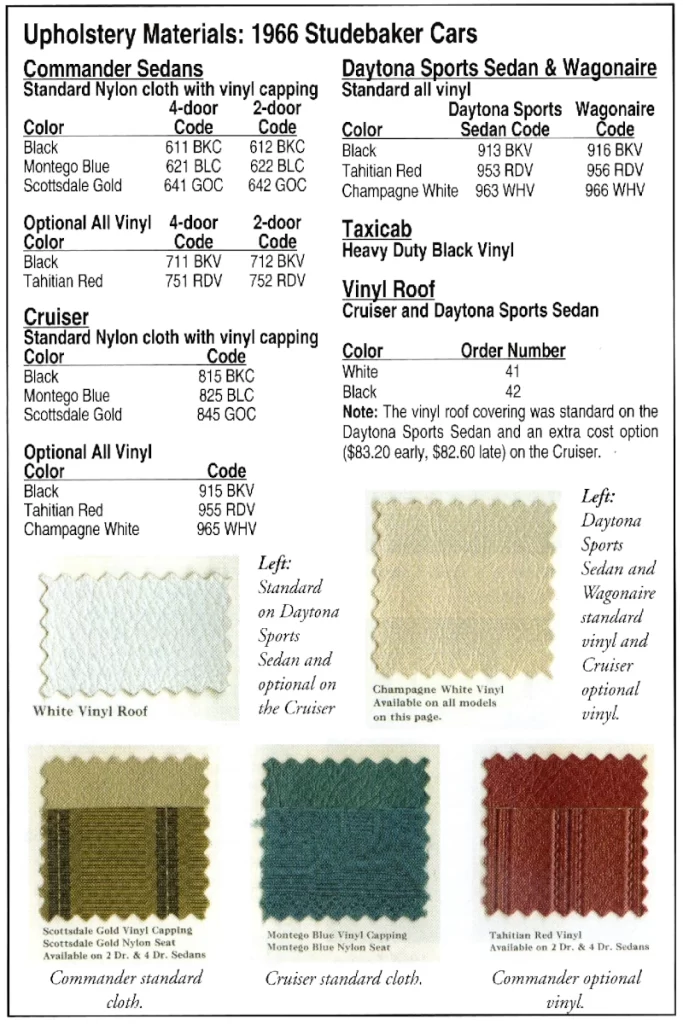
The Corporation would not foot the bill for any major changes, but did agree to some trim changes.  The final trim changes for 1966 were handled by Marcks, Hazelquist and Powers, a Dearborn, Michigan design firm.  These changes included a new grille, single headlights, lowered side moldings, optional Hawk-style full wheel covers, engine size front fender badges, sedan Refreshaire vents (see the side bar below for details about “Refreshaire”), lowered backup light lenses on sedans, new rear horizontal moldings on Daytonas and Cruisers, Daytona “earmuff” moldings adopted on the Cruiser, wood grain instrument panel overlays, black-instead of white-rocker switches and radio knobs, more black added to the horn button medallion, much plusher interior fabrics and narrower whitewall stripes.  The new grille and head- light rims were partially blacked out on Cruisers and Daytonas and left all bright metal on Commanders and Wagonaires.


Items introduced at the beginning or during the 1965 model year that were carried into 1966 included the McKinnon engines, color keyed steering wheels, standard parking brake warning light, standard windshield washer, suspended accelerator pedal, flanged rear axles (first offered on 1964 R3/R4 Avantis), transistorized ignition option (a 1964 R3/R4 Avanti feature-made standard on 1965 Daytonas), Daytona vinyl roof and an optional vinyl roof for the Cruiser (a late 1965 addition). Some of the early engineering changes were handled out of South Bend, but much of the work was done by Harm Arnold, Hamilton’s resident Chief Engineer.


Major tells for 1966 Studebaker Cars:

Twin (single per side) headlamps replaced the Quad headlamps seen on 1965 Models.  The grille was changed from a “egg crate” style grille to a painted grille with four retangular sections.


Side Bar:

New for 1966 was the Refreshaire system.  Standard equipment on sedans, this system allowed air brought in through the cowl vents or windows to be vented out through holes in the rear package shelf and then through the taillight vents shown above.  Interior flaps kept the system from drawing exhaust fumes back into the car.  The system required a relocation of the taillight lenses and backup lights.  The backup lights were the same style used on 1963-66 Wagonaires.  It was Studebaker’s last engineering innovation.
 

1966 Detailed Production

The following detailed 1966 production figures include transmission types, breakdowns between 194 and 230 Sixes, taxicabs and right-hand control models. These detailed figures come from Studebaker Form #C285 (Framing & Production Report Hamilton) supplied years ago to Art Unger by Jack Holden, Hamilton’s 1963-66 Supervisor of Scheduling.
Six ModelCode194 Std.230 Std.194 OD230 OD194 Auto230 AutoFloor 3-Spd RHC AutoRCH AutoTotalExports
 
Commander 2dr SedanS-F46725145101902761001,2453
Commander 4dr SedanS-Y447371164482378941001,88817
Daytona 2dr Sports SedanS-F83665891890002533
Cruiser 4Ddr Luxury SedanS-Y936121283131500041410
Wagonaire 4dr WagonS-P89020239111670003206
TaxicabS-Y4
T
0000126041001670
 
TOTAL 1,307160249836041,84143004,28739
 
V8 ModelCode283 Std. 283 OD 283 Auto Floor 3-SpdRHC Std.RCH AutoTotalExports
Commander 2dr SedanV-F445 30 122 0011981
Commander 4dr SedanV-Y4136 199 1,030 0212,36826
Daytona 2dr Sports SedanV-F825 51 544 0006204
Cruiser 4Ddr Luxury SedanV-Y933 75 1,733 0031,84413
Wagonaire 4dr WagonV-P850 80 486 0026185
 
TOTAL 289 435 3,915 0274,64849
 
GRAND TOTAL 1,596160684834,5191,84143278,93588*
* Exports included in production totals.

Models, Prices & Weights: 1966 Studebaker Cars

Six “S” Model C-13

ModelCodeEarly Price ($)Late Price ($)*Shipping Weight (lbs)
Commander 2dr SedanS-F42,2152,1982,695
Commander 4dr SedanS-Y42,3192,3022,815
Daytona 2dr Sports SedanS-F82,4442,4252,810
Cruiser 4dr luxury SedanS-Y92,5452,5262,815
Wagonaire 4dr WagonS-P82,6652,6453,246
Taxi 4dr SedanS-Y4T2,4512,433 
*After January 1, 1966

Note: Prices given are in U.S. dollars and include Federal Excise Tax.

V8 “V” Model C-53


ModelCodeEarly Price ($)Late Price ($)*Shipping Weight (lbs)
Commander 2dr SedanV-F42,3522,3352,891
Commander 4dr SedanV-Y42,4262,4382,991
Daytona 2dr Sports SedanV-F82,5812,5623,006
Cruiser 4dr luxury SedanV-Y92,6822,6633,066
Wagonaire 4dr WagonV-P82,8022,7813,501

*After January 1, 1966

Note: Prices given are in U.S. dollars and include Federal Excise Tax.


Note: The slightly lower U.S. prices introduced on January 1, 1966 were the result of a one percent reduction in the Federal Excise Tax on the dealer net price.  Window price stickers printed for Studebaker’s sold in the U.S. after December 31, 1965 included the following statement: “Distribution and Delivery Price Adjusted for 1 Percent Federal Excise Tax Reduction.”

Canadian & Export Prices:

As noted, the prices given for the 1966 models are in U.S. dollars for models sold in the United States.  Canadian prices were based on the same prices, but with the following adjustments.

These adjustments were the following:

  1. The difference in the value of the Canadian dollar versus the U.S. dollar.  In 1966,  the average exchange was 1.077 Canadian dollars to one U.S. Dollar.
  2. The difference between the U.S. Federal Excise Tax and the Canadian Federal Tax.  These taxes were applied to the price (“net price”) the dealer paid Studebaker for a vehicle.  They were included in the factory suggested retail “list price.”  For the 1966 model year, the U.S. Federal Excise Tax was 7% until December 31, 1965 and then on January 1, 1966 it was lowered to 6%.  By an odd coincidence, on March 16, 1966, the very day Studebaker assembled its last car, the Federal Excise Tax was raised again to 7%.  From a Canadian dealer (Clive Sales and Service, Ltd., Clive, Alberta) invoice provided by Craig Parslow, we know that on March 28, 1966, the Canadian Federal Tax was 11%.
  3. From the same invoice mentioned above, it is shown that the Climatizer was an extra cost option in Canada.  In the U.S., for 1966, it was a standard no charge item.  This is another factor to keep in mind when comparing U.S. and Canadian prices.
  4. In March 1965, the following was written in Studebaker’s 1964 Annual Report: “The removal of tariff barriers between the United States and Canada by action being taken by the respective Governments will be of assistance…” We do not know if, in Studebaker’s case these tariffs were completely removed.
 
Different factors come into play when analyzing 1966 Studebaker list prices in markets outside Canada and the U.S.  No 1966 models were shipped CKD (completely knocked down) to assembly plants outside of Canada, so all 1966 export Studebaker’s were assembled in the Hamilton plant.  As with the Canadian sold models,  the export model prices were based on U.S. prices, but with a different set of adjustments.

These adjustments were the following: 
  1. Studebaker International was headquartered in South Bend, Indiana, so foreign dealers paid for the cars in U.S. dollars. Studebaker provided these dealers with suggested retail list prices (minus shipping, handling and any tariffs), but, of course, it was up to the particular dealer to convert these prices to equivalent local currency.
  2. Studebaker vehicles shipped to export markets and sold in foreign countries were not subject to Federal Excise Tax or Canadian Federal Tax. If a foreigner had a car delivered in the U.S. or Canada different rules applied. Here is Studebaker International’s official statement on this situation: “U.S.A. Federal Excise Tax, or Canadian Federal Tax must be collected on cars delivered in the United States or Canada, except diplomats and other qualified persons, with acceptable official verification.”
  3. Three standard items on U.S. models were dropped from the export models. These were the Climatizer, outside rearview mirror and seat belts. Prices were adjusted to reflect these deletions. Of course, these items could be ordered as extra coat options.
1966 Distribution Totals
Body Type Body Code Sold in USA
2dr Sedan F 1,615
4dr Sedan Y 4,255
Wagon P 735
TOTAL  

US Total

6,605

 
Body Type Body Code Sold in Canada Export  Total US+Can+Export
2dr Sedan F 696 10 2,321
4dr Sedan Y 1,367 64 5,686
Wagon P 196 9 940
    Canada Total 2,259  Export Total 83* Total All  8947**
*This number is 5 less then given in the “Detailed” table above.
**This number is twelve greater the the detailed table above.  Evidently, 12 on this table were 1965 models.
Six ModelCodeProduction
Commander 2dr SedanS-F41,245
Commander 4dr SedanS-Y41,888
Daytona 2dr Sports SedanS-F8253
Cruiser 4Ddr Luxury SedanS-Y9414
Wagonaire 4dr WagonS-P8320
TaxicabS-Y4T167
 
TOTAL 4,287
 
V8 ModelCodeProduction
Commander 2dr SedanV-F4198
Commander 4dr SedanV-Y41,368
Daytona 2dr Sports SedanV-F8620
Cruiser 4Ddr Luxury SedanV-Y91,844
Wagonaire 4dr WagonV-P8618
 
TOTAL 4,648
 
GRAND TOTAL 8,935
Serial & Engine Numbers: 1966 Studebaker Cars

Serial Numbers

ModelStartingEnding
SixC-130,001C-134,293
V8C-530,001C-534,654

Starting Engine Numbers

ModelNumber
194 Six, Std. or OD01,610,001
194 Six, Automatic61,610,001
230 Six, Std. or OD*
230 Six, Automatic656,100,001
283 V8, Std. or OD176,400,001
283 V8, Automatic776,400,001

Special Notes:  Because of less than expected sales of 1965 models, some 1965 engines were left over at the end of the 1965 production run.  Approximately 383 (283 Std/OD and 100 auto).  1,965 six-cylinder engines and 590 (109 std./OD and 481 auto) 1965 V8 engines were used in the first 1966 models.  Those 1965 engines had different (than 1966) engine number ranges, so for the owner who has a 1966 Studebaker with a 1965 engine, here are the starting engine numbers for 1965 engines:

Starting 1965 Engine Numbers:

194 Six, Std. or OD6,510,001
194 Six, Automatic

66,510,001

283 V8, Std. or OD205,420,001
283 V8, Automatic805, 420,001

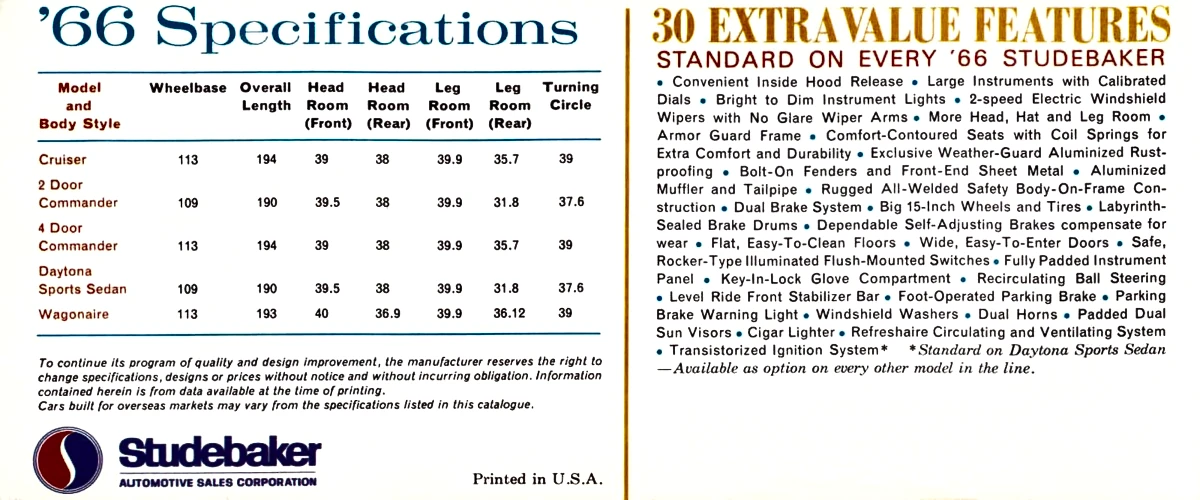
Specifications: 1966 Studebaker Cars

Engine194 Six230 Six283 V8
ValvesOHVOHVOHV
Displacement (cu.in.) 194230283
Bore (inches)03/09/1603/07/0803/07/08
Stroke (inches)03/01/0403/01/043
Compression ratio8.5:18.5:19.25:1
Horsepower@rpm120@4400140@4400195@4800
Torque (ft-lbs) @rpm177@2400220@1600285@2400
Carburetor-RochesterBV, 1bblBV, 1bbl2GV-2bbl

Wheelbase:

  1. Two-door Sedans: 109 inches

  2. Four-door Sedans and Wagons: 113 inches

Tires:

  1. 7.35 x 15 standard

  2. 7.35 x 15 optional


Fuel Tank: 18 gallons*


Cooling System:
Six: 12.5 quarts*
V8: 15.0 quarts*
Extra one quart added for Climatizer


*U.S. measurements.